
Reconnecting nature: biodiversity, a challenge for infrastructure
The world’s population has surged past the eight billion bar and shows no signs of stopping. Urban development (housing, roads and other types of infrastructure) is essential for meeting the population’s needs, but one of its downsides is that it fragments biodiversity and natural habitats, such as for wild animals, insects, fish or micro-organisms. Several solutions are available and currently being rolled out to minimise the impact that human constructions cause by splitting up wildlife’s territories and hampering their movement.
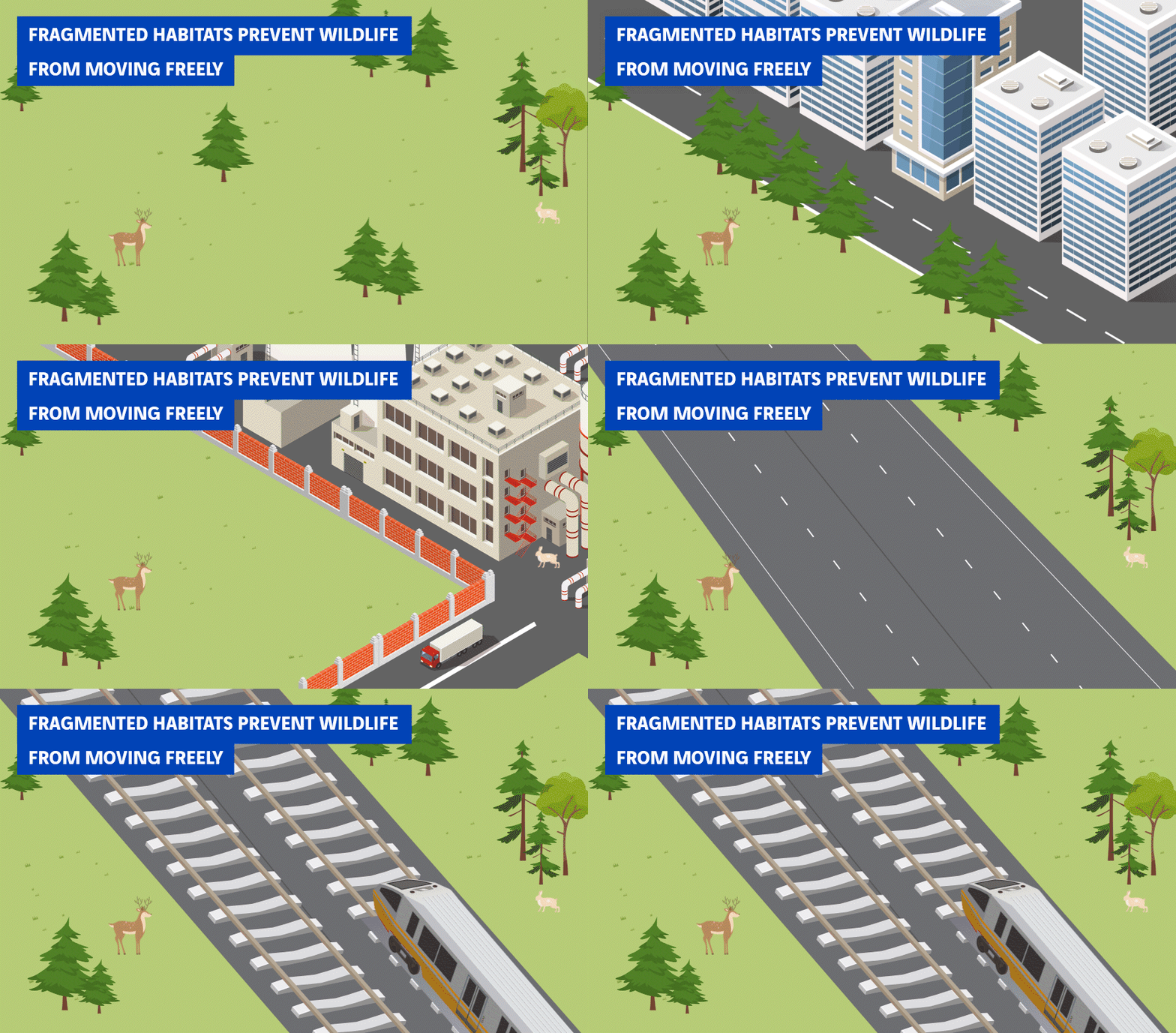
Biodiversity and fragmented habitats
Housing projects, expanding cities, new business developments and transport networks are changing the face of the natural environment. A building, a road, a railway line and a fence are just some of the physical barriers that prevent animals and insects from coming and going as they please. Depending on their size, some wildlife species can still make their way past these obstacles, but it can prove to be a perilous journey: 194 million birds and 29 million mammals are killed every year in Europe1.
Some species that are used to roaming freely across wide-open areas, whether for finding food or reproducing, are now limited in their movements after human activities have encroached on their natural habitat.
“To ensure the long-term success of biodiversity conservation, protected and conserved areas must be integrated into wider landscapes and seascapes, while promoting sustainable use that is fully consistent with conservation outcomes. This requires a commitment to integrated spatial planning, strong governance and collaborative management, ensuring both biodiversity protection and the enhancement of local livelihoods”2, stresses the 2024 Protected Planet Report, which is supported by the UN Environment Programme.
Awareness of the issue is clearly growing. Several States have enshrined biodiversity conservation in their spatial planning laws. In France, the law aimed at improving access to housing and renovating urban planning practices (the Alur Act), which was revised in March 2014, steps up the obligations for ensuring that spatial planning policies give greater focus to the environment, biodiversity and ecological continuity3. Businesses and associations also have a role to play. The VINCI Group has actually turned these issues into one of its three environmental objectives, i.e. act for the climate, optimise resources through the circular economy, and preserve natural environments. The Group is focused on its ambition of achieving "no net loss" of biodiversity by 2030" .
Balancing human needs with nature:
The challenge lies in scaling up the deployment of innovative solutions to stop biodiversity loss in its tracks.
Ecological engineering, colours and biodiversity
Let’s start with a few definitions that are essential for clearly understanding biodiversity issues and conservation.
- Ecological continuity: this concept refers to the free movement of animal and plant species on land or in aquatic environments. We often talk about ecological continuity in waterways, which concerns aquatic organisms and natural sediment transport4.
- Green corridors: this refers to the networks of natural terrestrial environments that allow animals and insects to move and colonise new areas.
- Blue corridors: this refers to the networks of water bodies (rivers, streams, canals, ponds, wetlands, etc.) that allow fish, amphibians and other water-dependent species to move and interact.
- Brown corridors: this refers to connecting networks in underground environments or the soil. Sometimes, soil sealing needs to be reversed so that micro-organism and microfauna life can survive.5
- Black corridors: this refers to preserving dark skies at night, which are vitally important for nocturnal animals, including bats, certain insects and migratory birds.

Meanwhile, ecological engineering harnesses scientific knowledge, techniques and practices based on the living environment (wildlife, plant-life and biodiversity) to sustainably design, restore, manage or develop natural or urbanised environments6. Equo Vivo7 is VINCI Construction’s dedicated brand for carrying out ecological development projects, including green and blue corridors, or renaturing and restoring wetlands and waterways.

Existing schemes: wildlife crossings, urban greening…
Wildlife crossings can be created along roads, railway lines and even dams blocking waterways. Eco-bridges, ecoducts, bat gantries, amphibian tunnels and fish passes are being deployed across France and abroad.

In Brazil, Entrevias (VINCI Highways / VINCI Concessions) has already built 44 wildlife crossings across its 570 km motorway network, and 30 more were under construction by the end of 2024, primarily along the SP-333 between entre Marília and Florínea. These crossings are designed to protect a wide variety of species, such as jaguars, deer, capybaras, reptiles and birds. For an even more effective response, fencing is being installed along the motorways to direct animals towards the crossings so that they can safely reach the other side.

Wildlife crossing
In France, VINCI Autoroutes is also implementing these solutions. By the end of 2022, there were 178 crossings on 21 motorways within the VINCI Autoroutes network8. Despite these tremendous efforts, the whole of the French network has yet to be covered, but work is continuing with this goal in mind, and the wealth of data collected by dedicated structures (chamber of agriculture, French National Forestry Office, associations, etc.) are encouraging. For example, 21 wild species have been detected using the 15 eco-bridges recently created throughout the VINCI Autoroutes network9.

Animals photographed near a wildlife crossing on the VINCI Autoroutes network (VINCI Concessions).

Animal photographed near a wildlife crossing on the VINCI Autoroutes network (VINCI Concessions).

Animal photographed near a wildlife crossing on the VINCI Autoroutes network (VINCI Concessions).

Animal photographed near a wildlife crossing on the VINCI Autoroutes network (VINCI Concessions).
In urban areas, along with efforts to conserve natural and wooded areas, biodiversity reservoirs are being created, namely greenways or green corridors. In some cases, soil-sealed areas need to be redeveloped, where the ground surface is first made permeable and then replanted. During the summer of 2022, EJL’s Vitry-sur-Seine agency (a VINCI Construction subsidiary) redeveloped two primary school playgrounds in Vincennes and created an open-air water circulation system with channels, rock streams, and swales fed by rainwater harvesting tanks. As for spatial planning, some architectural solutions, such as using green roofs and walls, integrating shared gardens and parks into cities, and planting flowers for pollinators, are also aimed at protecting nature and biodiversity.

L’agence EJL (VINCI Construction) de Vitry-sur-Seine a été sélectionnée par la mairie de Vincennes pour réaliser le projet pilote de son programme cours ILOT visant à réaménager les cours d’écoles de la commune en "trame verte".

Objectif 1 : diminuer les surfaces d’enrobés et de les remplacer par des surfaces végétalisées et naturelles

Objectif 2 : remplacer l’enrobé noir par de l’enrobé beige afin de réduire l’albédo des revêtements et de lutter contre les effets d'îlots de chaleur urbain (ICU)

Objectif 3 : création d’un schéma de circulation des eaux à ciel ouvert grâce à des canaux, des rivières en empierrements et des noues d’infiltration alimentés par les cuves de récupération d'eaux pluviales.
Light pollution in cities plays havoc with the migration and reproduction cycles for some nocturnal species. Black corridors help maintain darkness at night, which is essential for animals and insects. With a helping hand from ecology experts, VINCI Energies subsidiary Citeos inventoried the different species inhabiting the city of Blois in France, determined the nesting periods and offered to provide the authorities with solutions designed to have a low impact on nocturnal biodiversity. With warmer orange lights and projectors that are no longer pointed at the sky or water, and which switch off at 10:30 pm, the city has seen an increase in its energy performance, while helping tackle light pollution. Citizens and local authorities must be consulted to gain their acceptance for these types of solutions.

The joint benefits of biodiversity conservation
Human beings are an integral part of a complex ecosystem where all species play a role in maintaining the status quo. According to estimates, 44% of the world’s gross added value depends on the state of the planet’s biodiversity10. By reversing the decline in bird populations, which is estimated to be 25% in Europe and up to 60% in agricultural areas11, there are hopes of slowing down the spread of the vermin species that birds feed on, such as disease-carrying mosquitos. Similarly, saving bees and other pollinators can help preserve the production of 70% of the crops that depend on these insects12. Protecting plant species could have an indirect effect on human health, bearing in mind that some varieties have proven medicinal properties or potential healing powers. Preserving wooded areas and living species is also a tremendous weapon for combatting pollution, which is the second leading risk factor for death13.
Companies and local authorities are especially effective at taking action, particularly if biodiversity issues are taken into consideration during the earliest stages when designing urban and infrastructure projects.
Sources :
1 Libération : “Watch out for elk” – https://www.liberation.fr/forums/la-prudence-du-wapiti-20250330_ENJIK6NLAVDSHISDOYH3PO37U4/
University of Reding : "Roadkill risk and population vulnerability in European birds and mammals” – https://centaur.reading.ac.uk/89172/16/Grilo%20et%20al_2020_Frontiers.pdf
2 Protected Planet Report 2024 : “Executive summary” – https://pp-digital-report-document.s3.eu-west-2.amazonaws.com/Protected+Planet+Report+2024_Executive+Summary.pdf
3 Alur Act, Ministry for Housing and Territorial Equality: “Biodiversity in local planning regulations and territorial coherence plans” – https://www.ecologie.gouv.fr/sites/default/files/documents/alur_fiche_la_biodiversite_dans_les_plu_et_scot.pdf
4 Ministries for the Ecological Transition, Spatial Planning, Transport, Cities and Housing: “Green and blue corridors” –https://www.ecologie.gouv.fr/politiques-publiques/trame-verte-bleue
5 Sol&Co : “Brown corridors: Why? How? Which limitations?” –https://www.trameverteetbleue.fr/sites/default/files/3_jet_nouvellestrames_2023_vincent.pdf
6 Ministries for the Ecological Transition, Spatial Planning, Transport, Cities and Housing: “Ecological engineering roadmap for 2030” – https://www.ecologie.gouv.fr/politiques-publiques/feuille-route-ingenierie-genie-ecologiques-horizon-2030?utm#quand-faire-appel-a-lingenierie-et-au-genie-ecologiques-1
8 VINCI Autoroutes : “Ecological continuity. Feedback 2” –https://www.trameverteetbleue.fr/sites/default/files/3-ppt_jet_paf_chavaren_vf.pdf
9 Ibid.
10 Biodiversité.gouv : “The five pressures responsible for biodiversity loss” – https://biodiversite.gouv.fr/en/living-harmony-nature
11 CNRS : “Agricultural intensification is driving a decline in bird populations across Europe” – https://www.cnrs.fr/en/press/agricultural-intensification-driving-decline-bird-populations-across-europe
12 Biodiversité.gouv : “Biodiversity: what purpose does it serve?” – https://biodiversite.gouv.fr/en/living-harmony-nature
13 VINCI : conférence “The joint environmental benefits for the economy, health and well-being, at l’archipel”
Subscribe
Stay tuned : receive our newsletter
Every quarter, discover new articles, exclusive features and experts' views delivered straight to your inbox.
Most viewed
Explore more

Electrification: the key driver for industrial decarbonisation
Despite the efforts already made around the world to limit greenhouse gas emissions and their impact on our environment,…

Building to care: meeting the demanding standards of hospital buildings
The hospital has a single mission: to welcome, treat and help large numbers of patients, their families and friends through…

Mixed-use developments: bringing different urban uses together
Built to replace neighbourhoods that have outlived their usefulness or on brownfield sites, mixed-use urban development…