
Access to water in Africa: persistent challenges despite major progress
When looking at the situation of safely managed water supplies in Africa, the glass could be seen as half full, rather than half empty. The progress identified by the World Health Organisation (WHO) and the United Nations Children’s Fund (UNICEF) in their joint report published in August 2025 relates to the fact that between 2000 and 2024, access to drinking water and safely managed sanitation services rose faster than the increase in the global population, which can be interpreted as an overall improvement.

But the glass could also be seen as half empty, since the number of people lacking complete access to water fell slowly over the same period, and progress has been considerably uneven. In particular, sub-Saharan Africa continues to top the list of the regions most affected by water-related issues.
The situation concerning access to drinking water in Africa
According to the tracking indicators published by WHO and UNICEF, nearly one third of the population in Africa (over 400 million people) still lacks access to at least basic drinking water.

When it comes to sanitation services (meaning a household’s access to toilets that are not shared with other households and which are connected to a sewer system or septic tank), the lack of infrastructure is even more glaring, with two thirds of the population still lacking basic services.

Sources of the water access problem in Africa: contrasting hydromorphic conditions
Africa is such an immense continent that extreme variations can be found from one region to the next.

All it takes is a simple glance at a global satellite image to realise the scale of the stark differences in hydrography across Africa. In the north and south of the continent, the Sahara and Kalahari Deserts (among the driest places on Earth) seemingly ensnare a vast and extremely humid tropical belt featuring gigantic lakes (Chad, Victoria, Tanganyika, Malawi, etc..) and watersheds feeding some of the world’s largest rivers, including the Nile, Congo, Niger and Zambezi.
Consequently, Africa is not theoretically in short supply of water resources, with approximately 9%2 of the planet’s freshwater reserves (for 18%3 of the world’s population). But it does lack the appropriate infrastructure to treat and transport water when and where inhabitants need it.
The harmful effect of climate change on inequalities in access to water in Africa
Another major factor that should be taken into consideration is the effects of climate change, which is having a severe and direct impact on access to water across the entire continent.
Unforeseeable changes in rain and snow systems are disrupting river and groundwater levels. Droughts reduce water intake, while violent and heavy rainstorms can lead to fast runoffs with dangerous and devastating effects for people, wildlife and infrastructure, which are then faced with the increased risk of flooding and contamination. Above all, these runoffs sweep in with such force, that the water is unable to sustainably seep into the soil and naturally refill the groundwater. As an added complication, glaciers are melting as temperatures continue to soar, meaning that they are unable to perform their role as freshwater reserves and regularly feed into the continent’s waterways. Meanwhile, rising sea levels are endangering shorelines and increasing salinity concentrations in coastal aquifers.

These changes can also have repercussions on a country’s business and social models. For example, the Zambezi River lost 20% of its average flow rate in 2024, which sparked a major energy crisis in Zambia, since the country’s main hydroelectric plant could only run at 7% capacity4.
Droughts are not only striking with greater intensity, but they are lasting longer, which causes waterways and wells to dry up and jeopardises the survival of people, their livestock and their crops, without forgetting wildlife and biodiversity. In Zimbabwe, water shortages in 2024 wrought havoc with the country’s maize harvests, which plummeted by 70%, while maize prices doubled. Over 9,000 cattle died of thirst and starvation.5

The snows of Kilimanjaro could soon be a distant memory...
Tanzania’s Mount Kilimanjaro, an iconic feature of the African landscape, could soon permanently lose its famous snow cap. Known as the “roof of Africa” and reaching an altitude of nearly 6,000 metres, the mountain’s glacier has lost more than 90% of its surface area since the 1900s6. At this rate, it could disappear completely by 2050, just like all the other large glaciers in East Africa.
Water and Africa: the demographic and urban challenges keep pliling up
Population growth is another contributing factor to Africa’s water supply challenges. Since the 1990s, the continent’s population has more than doubled7. Its infrastructure was already lagging behind, and now that gap has widened further. The phenomenon tends to hit hardest in urban areas, since this is where most investments to develop drinking water and sanitation networks are being focused. African cities are developing at an average rate of 3.5% a year, but they are absorbing 80% of the continent’s population growth.
60
The number of cities in Africa with over one million inhabitants. This figure will pass the 150 mark by 20508.
Priorisiting water supplies to address the urban challenge
Transporting water and connecting the soaring number of city dwellers to a drinking water service is both a daunting challenge and a top priority in Africa. Sogea-Satom, a VINCI Construction subsidiary and a leading player in developing hydraulic infrastructure across Africa, is actively involved in several high-impact projects to improve water supplies in the continent’s fast-growing cities.
In Chad, a project was launched early 2025 to drill three wells, create a 6,000 cu. metre reservoir and lay 16 km of pipes in N’Djamena, the country’s capital. The work will help increase the water network’s coverage rate from the current 30% to 45% of the city’s population in 2027.
In Burkina Faso, the water supply network was reinforced in the business capital Bobo-Dioulasso in August 2025 by drilling five new wells, building a 5,000 cu. metre reservoir and installing or renovating 25 km of pipes.
In Côte d’Ivoire, Sogea-Satom and VINCI Construction Grands Projets recently wrapped up an innovative project for the city of Abidjan, which involved building a 300 t floating pumping station on the Aghien lagoon with the capacity to produce 150,000 cu. metres of drinking water every day.
Urban and rural water supplies: significant disparities in Africa
One of the main disparities highlighted by the indicators published by WHO and UNICEF concerns the gaps in coverage between urban and rural areas. The abovementioned report estimates that three in five people with access to safely managed drinking water lived in cities, while 90% of people who still depended on surface water lived in rural areas. Nowhere in the world is the disparity between cities and urban areas higher than in sub-Saharan Africa.


Sharing rural facilities
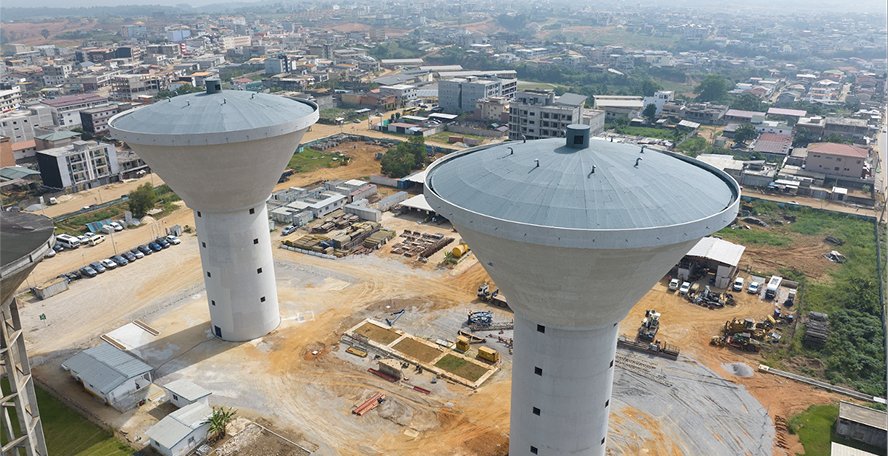
In Benin, a new approach is being implemented as part of a long-term government plan to cover 100% of the population, which involves rolling out multi-village drinking water supply systems (SAEPmV) with the aim of pooling facilities to optimise costs and sharing the process of managing water resources in rural areas featuring lower population densities. Between 2023 and 2025, VINCI Construction subsidiary Sogea-Satom built 24 of these SAEPmV systems, each with its own water tower, wells and pipes. This was a gargantuan project in terms of both its scale and impact, with work carried out in 13 municipalities across three departments in the north and centre of the country, spanning a surface area of more than 45,000 sq. km and ultimately serving over 500,000 inhabitants living in Benin’s rural areas.
Rural areas: harnessing water to drive irrigation and electricity
The other major challenge with managing water resources in rural areas is irrigation. Once again, African infrastructure still appears to be insufficient for fulfilling 100% of the population’s needs and offsetting the impacts of climate change. Almost all farmers rely on rainwater, and less than 10% of cultivated land is irrigated9. One of the solutions for developing irrigation systems involves building dams, canals and pipelines. A second upside is the prospect of generating carbon-free electricity. Despite its major rivers, Africa is currently only tapping into 5% of its hydroelectric potential10. But this latent market is continuing to attract greater attention, with over 18.5 GW of projects already in the pipeline. When combined with the 16 GW of facilities currently under construction, these projects could ultimately bolster the continent’s hydroelectric production capacity by close to 80%11.

The case of the Saïss plain
Morocco has been forging ahead with a wide-ranging hydraulic infrastructure programme since the 1990s with the aim of connecting the water reserves in the Atlas and Rif Mountains to the country’s arid central and southern regions, which are hit by longer and more frequent droughts every year. As part of this long-term national strategy, Sogea Maroc was contracted to lead a megaproject in the Saïss region. This sprawling agricultural plain is one of the country’s most fertile areas, but its once abundant groundwater supply was suffering from an increasingly irregular rain cycle. In an effort to offset this effect of climate change, the contract required the teams to lay over 50 km of buried metal pipes with a diameter of 3.20 m, while building various structures, tracks and powerlines to connect the new M'Dez dam (a reserve of 700 million cu. metres) to over 7,000 farms across the plain. Work began in 2018 and was completed in 2025.


The water challenge in Africa: ensuring a stream of investments
For several years, public authorities across Africa and international financial institutions have generally been giving greater focus to the water access issues plaguing the continent. The hydraulic works market may be booming across the entire continent, but investments are a long way from reaching the levels required to achieve the Sustainable Development Goals in the UN Agenda 2030, especially when compared to those in the most advanced economies..

Far from the 10 to 19 billion dollars currently spent every year, the OECD estimates that
US$64 billion needs to be invested per year (i.e. approximately $50 per capita per year) to ensure water supplies for the whole of the continent’s population13. Many obstacles still stand in the way. For example, the technical complexity of hydraulic projects weighs down on their intrinsic return on investment, while the economic instability and political unrest seen in some regions restrict how much public authorities are willing to invest and increase the risks for private investors.
Yet according to WHO, the ROI is high, especially for the most vulnerable populations, where the multiplier for the return on every dollar invested in infrastructure has been estimated to be 2 for water supply and 5.5 for sanitation14.
A source of hope for the years ahead?
Sources :
2 https://brgm.hal.science/hal-01366415v1/file/FR_GEOSCIENCES21_58_66.pdf
3 https://fr.wikipedia.org/wiki/D%C3%A9mographie_de_l%27Afrique
7 https://fr.wikipedia.org/wiki/D%C3%A9mographie_de_l%27Afrique
8 https://africacenter.org/fr/spotlight/urbanisation-rapide-afrique-securite/
9 https://en.wikipedia.org/wiki/Water_scarcity_in_Africa
10 https://fr.wikipedia.org/wiki/Histoire_de_l%27hydro%C3%A9lectricit%C3%A9_en_Afrique
Subscribe
Stay tuned : receive our newsletter
Every quarter, discover new articles, exclusive features and experts' views delivered straight to your inbox.
Most viewed
Explore more

Marina Lévy - Companies at the heart of ocean conservation issues
Marina Lévy, oceanographer, research director at the CNRS and ocean advisor to the president of the French National Research…

Building with and for nature
Whether creating barrages, stripping away topsoil, cutting down trees or digging channels, humans have spent thousands of…

Bridging the construction gender gap: paving the way to a career in industry for women in Colombia
In 2025, the Ruta 40 consortium led by VINCI Construction Grands Projets completed work on widening and upgrading the Bogotá…