
VINCI Railways finances, designs, builds, maintains and operates rail and urban transport infrastructure. In France, it manages the South Europe Atlantic high-speed rail line, the GSM-Rail communications network and a part of the reserved lane public transport system in the French overseas territory of Martinique.
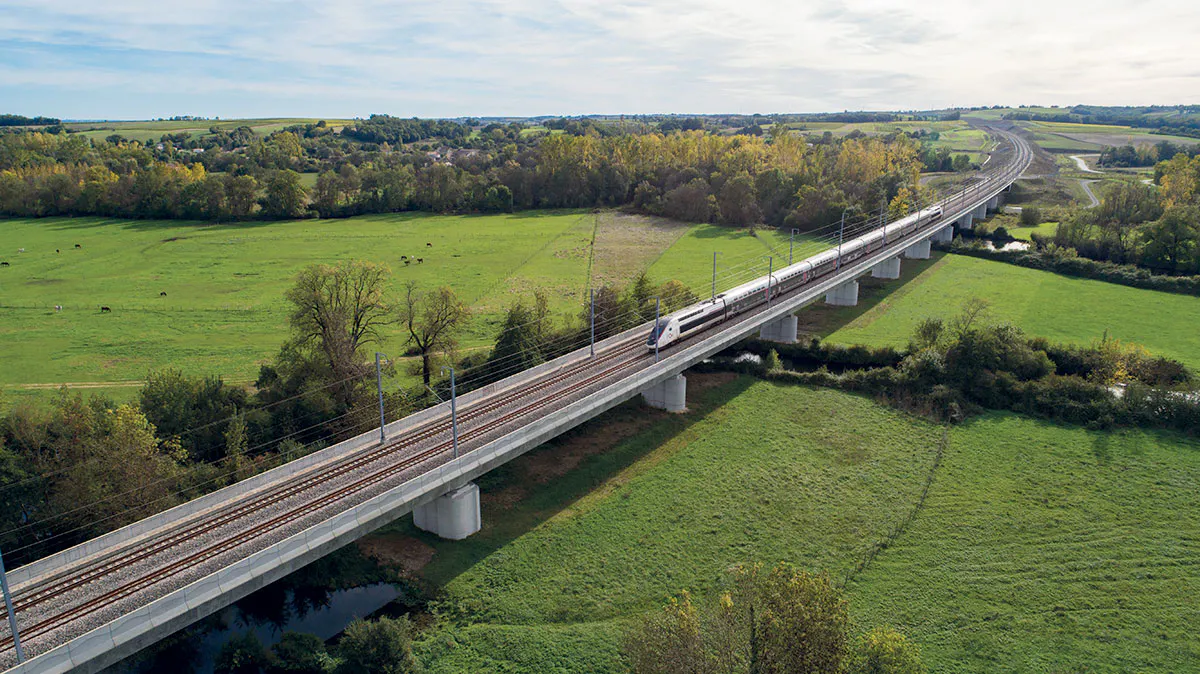
More than half of train routes on the SEA HSL are still available, as France’s passenger rail market opens to competition.
Designed, built and operated by VINCI and its shareholder partners in LISEA, under a concession contract with SNCF Réseau running until 2061, the Tours–Bordeaux South Europe Atlantic high speed rail line (SEAHSL) 340 km including 38 km of connecting lines connects Paris to Bordeaux in just two hours. The second busiest high-speed line in France, after Paris–Lyon, it recorded 25,493 train movements in 2023, representing a capacity of over 22 million seats and a 3.4% increase over the year. Since being brought into service in 2017, the SEA HSL has served more than 110 million passengers and has contributed to the development of the greater Bordeaux area and the broader south-west region of France.
With demand for mobility outpacing supply on the French high-speed rail network, and more than half of train routes still available, the concession company LISEA is working to develop additional connections and preparing to welcome new operators as France’s passenger rail market opens to competition. To this end, it is offering incentives to develop new services in the form of discounts of up to 50% on fees for the first year. LISEA has also launched a project to build a maintenance and repairs site for trains with high-speed capability in Marcheprime, a town near Bordeaux, given that development of additional rail routes depends on the availability of new capacities in this area. The multipurpose work-shop, designed to meet the needs of two operators simul-taneously, represents an investment of almost €200 million. Scheduled to be brought into service in 2027, the site will allow creation of several hundred jobs
LISEA and MESEA, the company responsible for maintenance of the line, work hand in hand to guarantee, first and foremost, the safety of train movements, thanks to a safety management system committed to continuous improvement. All employees and management are involved in achieving this goal, in close collaboration with SNCF Réseau and the rail companies. Initial and ongoing training of employees is an essential link in the chain. As such, the MESEA Academy, a training centre certified by the French national rail safety authority (EPSF), delivered more than 11,000 hours of training in 2023. The technical performance of both operating and maintenance activities contribute to the line’s service regularity, which exceeded 96% in 2023–99.7% taking into account only incidents attributable to the concession company. The triple certification obtained by MESEA in 2022 and confirmed in 2023 for Quality Management (ISO 9001), Environmental Management (ISO 14001) and Occupational Health and Safety Management (ISO 45001) is a prime factor in winning the trust of rail operators.
These results are further driven by methods and tools at the cutting edge of technological innovation. For example, the DRING wagon is a tow vehicle integrating a 2D LiDAR sensor for inspecting track geometry, and the Hypervision real-time monitoring system centralises all alerts and data from equipment concerning train traffic. The SEACloud platform developed jointly by LISEA and MESEA harvests data generated by infrastructure to gain in-depth knowledge of the asset, anticipate incidents by harnessing artificial intelligence, and provide predictive maintenance. By way of example, SEACloud can predict changes in track geometry over the next 18 months.