
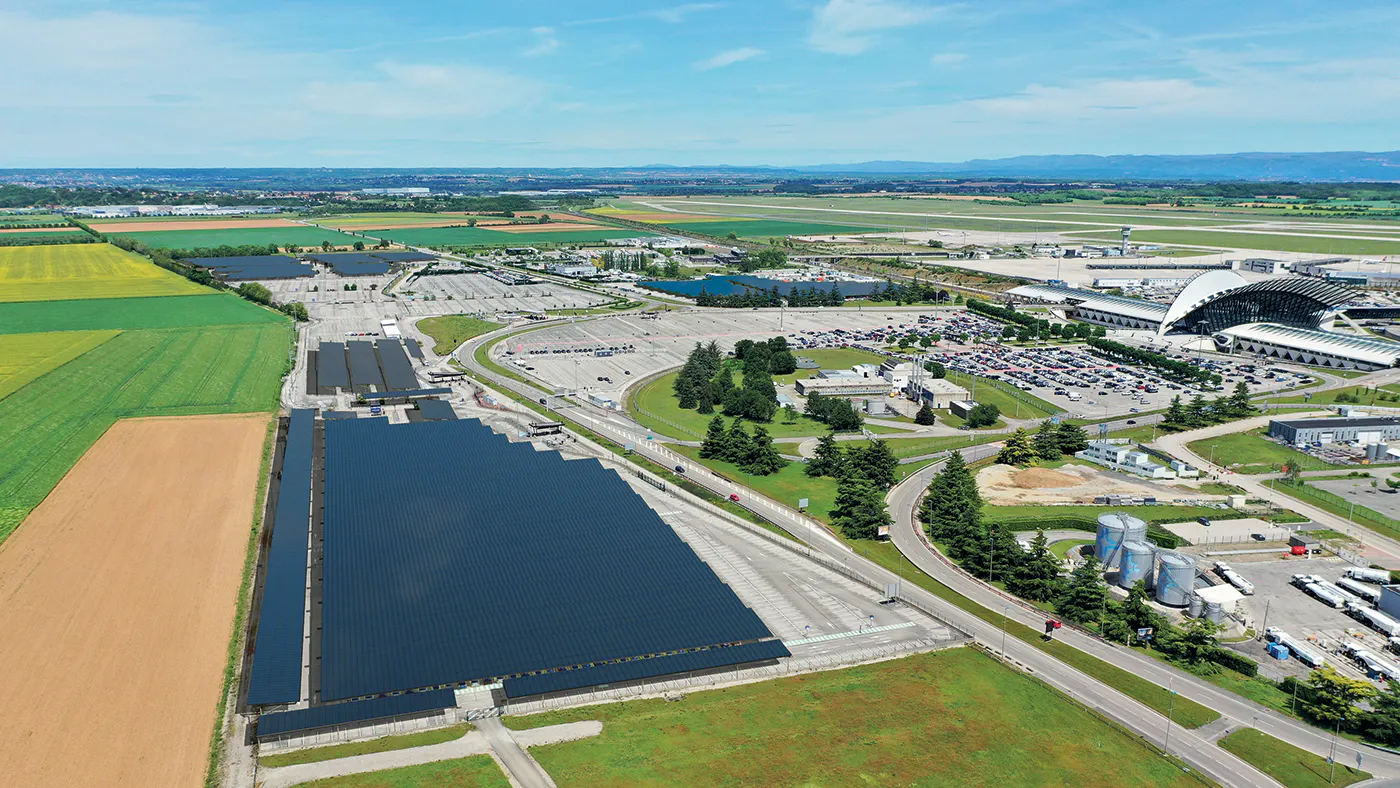
At Lyon-Saint Exupéry airport, the VINCI Concessions subsidiary SunMind partnered with Neoen to deploy one of France's largest solar canopies, spanning 14 hectares, with a capacity of 20 MWp (computer-generated image).
To guide progress in reducing their carbon footprint, all airports in the network join the Airport Carbon Accreditation (ACA) programme launched by Airports Council International (ACI). Thanks to the continuous efforts made by VINCI Airports teams and their partners, 10 airports reached Level 4+ Transition (seven airports in Portugal, the airports in Lyon and London Gatwick) in 2023. In addition, four airports (Toulon Hyères in France; Beja, Funchal in Madeira, and Ponta Delgada in the Azores, in Portugal) were awarded Level 5 accreditation, which means they deliver net zero emissions for Scopes 1 and 2.
Meanwhile, VINCI Airports is also taking action to reduce its indirect emissions (Scope 3) by encouraging airlines to decarbonise their own activities, through two complementary initiatives. The first is a scheme to modulate airport landing fees based on aircraft emissions, starting in France and at London Gatwick. The second initiative is sustainable aviation fuels (SAF). Produced from used cooking oil and with a carbon footprint 80% lower than conventional aviation fuel, these biofuels are now available at four airports in France: Toulon Hyères (see Close-up), Clermont-Ferrand Auvergne, Grenoble Alpes Isère and Saint-Nazaire Montoir since 2023.
In addition, in line with the Group’s investment in the Clean H2 Infra fund the world’s first low-carbon hydrogen fund VINCI Airports is collaborating with key industrial players in its sector to develop the use of clean hydrogen in aviation. Hydrogen powered buses are already in service at Lyon-Saint Exupéry and in Japan (Kansai International and Osaka Itami), as a prelude to later development of the infrastructure required for hydrogen powered aircraft at airports in the longer term.