
Innovation contributes to the improvement in service quality. At Lyon-Saint Exupéry, for instance, VINCI Airports partnered with the French civil aviation authority to trial a new technology that automatically detects explosives. This innovation prevents passengers from having to take their electronic devices and liquid or aerosol products out of their cabin bags at control points, for a smoother customer pathway. Also used for explosive detection, Standard 3 X-ray systems will be installed in 2024 at Belfast and London Gatwick airports in the United Kingdom.
The first airport operator to have implemented an environmental strategy on a global scale, in 2016, VINCI Airports aims to achieve net zero emissions for its direct scope (Scopes 1 and 2) by 2030 for its airports in the European Union, as well as London Gatwick, and by 2050 in the rest of the world. The installation of solar power plants in its airports, primarily for the purposes of self-consumption, is an important lever to attain these goals. Drawing on the expertise of the specialised VINCI Concessions subsidiary SunMind, VINCI Airports also launched construction of solar power plants in 2023 at the airports of Porto Santo in Portugal, Belfast in the United Kingdom, and Lyon-Saint Exupéry in France. The latter will see deployment of one of the country’s largest solar canopies – 14 hectares of roofing covering 5,800 parking spaces, with a capacity of 20 MWp. At end 2023, the 34 solar power plants in operation across the VINCI Airports network had a total installed capacity of 48 MWp. The decarbonisation programmes implemented at network airports include a set of initiatives such as installing LED lighting and efficient heating and airconditioning systems in buildings and switching to electric service vehicles. By the end of 2023, these measures, taken together, had reduced the direct carbon footprint of the network’s airports by 50% from 2018 levels. Meanwhile, since 2021, VINCI Airports has been developing land rehabilitation initiatives to offset residual emissions. These measures are already deployed near the Faro, Porto and Lisbon airports in Portugal, and at Toulon and Lyon-Saint Exupéry airports in France, with reforestation programmes in partnership with the French National Forest Office (ONF) and the Var department, and the Grandes Cultures project with the Rhône Chamber of Agriculture. In Japan, Kansai Airports is working on the Sea Forest (Seaweed Beds) Conservation and Restoration Project covering 54 hectares of undersea plants.
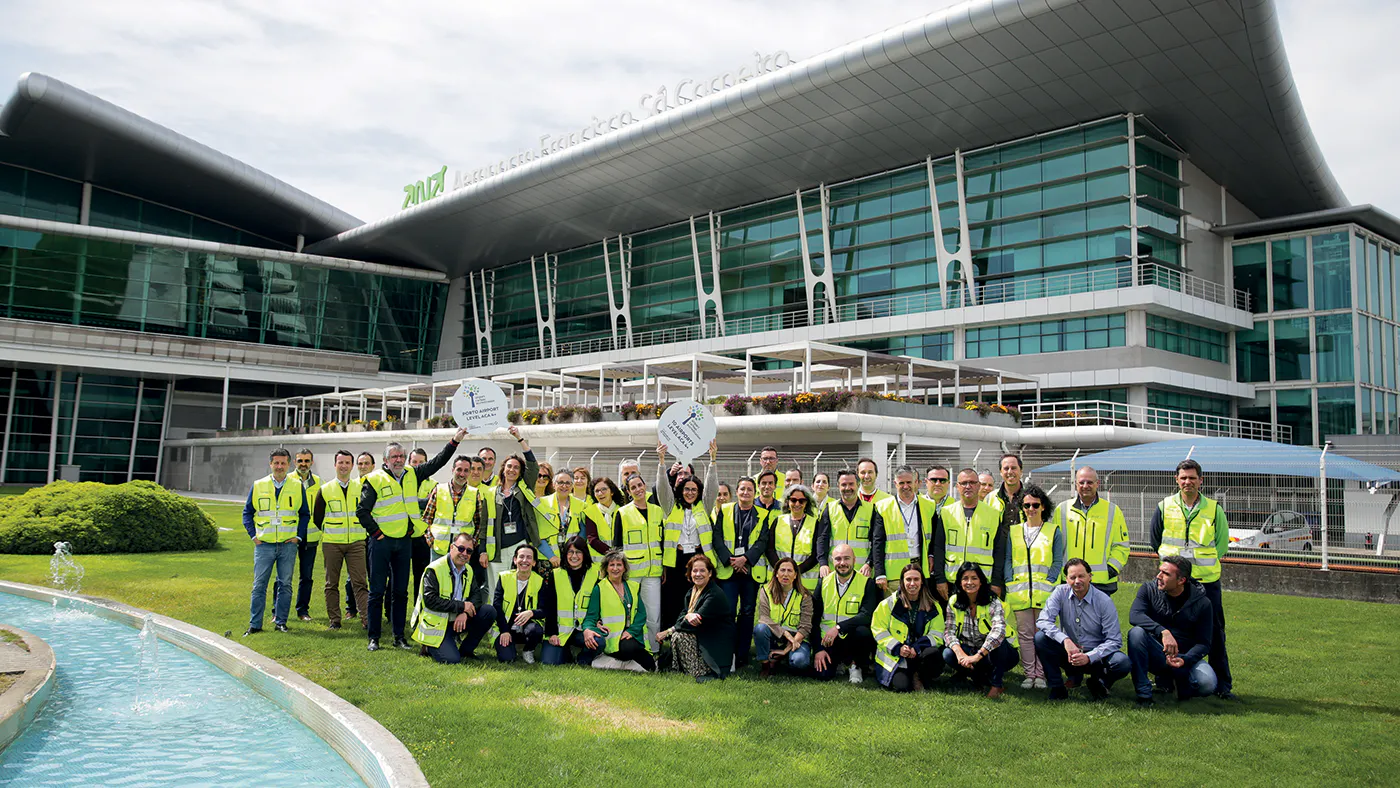
In Portugal, staff at the airport of Porto (above) achieved Level 4 ACA environmental accreditation, and the airport of Faro set up a solar power plant in 2022 that now supplies 30% of the electricity it consumes.