
 CLOSE-UP
The experiments carried out in real-world conditions on the A10 will be a world first.
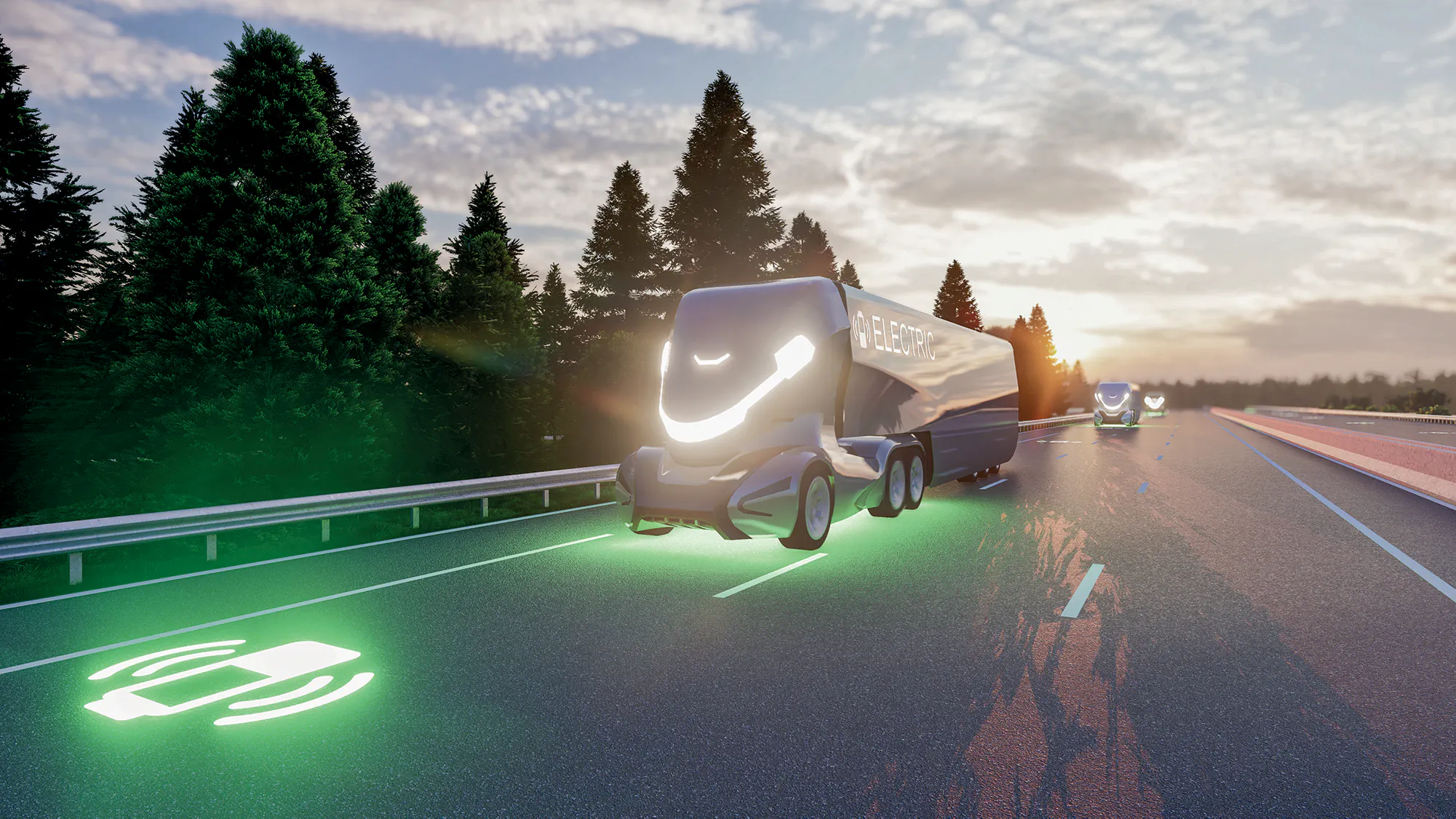
A consortium bringing together VINCI Autoroutes (lead), teams from VINCI Construction’s roadworks operations, Gustave Eiffel University, Hutchinson and two technology suppliers, along with support from Cerema, the French public expertise centre for research on the environment, was selected in 2023 on a BPI France call for projects to decarbonise mobility. The project, a world first for this type of motorway, aims to conduct experiments in real-life traffic conditions along two trial sections, spanning 2 km each. Two dynamic charging solutions for electric heavy vehicles are being tested: the first uses an inductive coil embedded in the roadway and the second a conductive central rail.
Tests will first be conducted on a closed circuit at a Gustave Eiffel University site in Nantes, before installing the two systems at the pilot site on the A10, in the direction heading south from Paris before the Saint-Arnoult-en-Yvelines toll plaza. These technologies will then be integrated into motorway sections over longer distances.
Dynamic charging systems are a major driver in decarbonising road freight transport. If they are implemented, the size of electric heavy vehicle batteries could be reduced considerably. The usual configuration would require batteries weighing several tonnes, in combination with 1 MW charge points. However, the large-scale rollout of systems like these could reduce emissions of CO2 generated by road freight transport by 86% compared with petrol-powered vehicles.
Demonstrators of these technologies, which are nearing industrial maturity, are in use in several other European countries, in particular in Germany, where VINCI Construction and VINCI Energies are participating in projects that experiment with inductive charging in Karlsruhe, Balingen and Cologne.
“ The rapid advances in light vehicle electrification must not overshadow the other great area of development, which is heavy vehicles. It is also crucial to lower heavy vehicle emissions by 86%, as soon as electrification makes it possible, which will have a very positive impact on air quality and on noise pollution. ”