
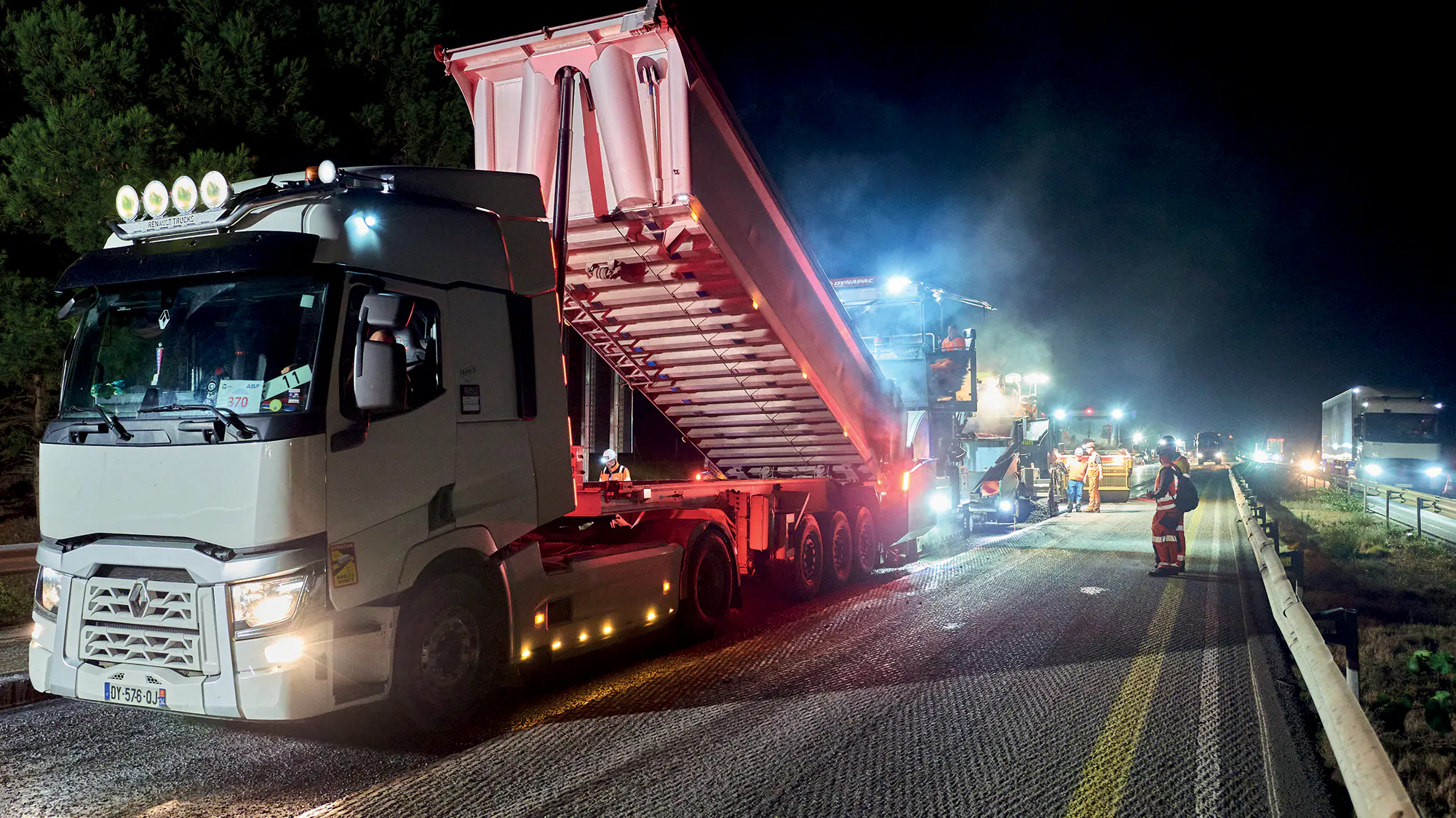
On the A61 resurfacing project between Carcassonne and Lézignan,
a significant portion of the asphalt pavement from the old road was reused in the new one.
In all, around 3.9 million hours of roadworks were carried out on the VINCI Autoroutes network in 2023. Most of these worksites were involved in professional integration programmes. These initiatives for the longterm unemployed are implemented in collaboration with public works companies and local unemployment offices. Participants in these programmes clocked some 82,000 integration hours on the A61 widening worksite. On the A10 project south of Tours and north of Orléans, 293 people were hired and trained through professional integration employment contracts.
WORKSITE CARBON FOOTPRINT AND MATERIALS RECYCLING
In its environmental policy, VINCI Autoroutes pledged to reduce the carbon footprint of the works it carries out on the road networks by an average of 50% by 2030 compared with 2018. This represents around half of its indirect upstream Scope 3 emissions. The measures rolled out in collaboration between programme management teams, contracting partners and construction companies have reduced the 2023 carbon footprint of worksites by an average of 20% per project compared with the 2019 baseline. These measures include the growing use of low-carbon concrete and recycled steel, as well as advanced recycling processes and implementation of road surfaces, which also aim to meet decarbonisation and circular economy targets.
The road renovation works regularly carried out by VINCI Autoroutes involve the extraction of significant quantities of aggregates – around 1.2 million tonnes a year. Of these materials, 96.5% is already being reused in various forms, and nearly 50% on VINCI Autoroutes’ own projects. The advances made in the road sector have made it possible to regularly increase the percentage of materials reused in-situ. For example, during resurfacing works carried out over 46 km of the A61 (23 km in each direction) between Carcassonne and Lézignan, in southern France, 70% of the base layers and 50% of the wearing course employ asphalt mix extracted from the old roadways. Materials that could not be reused on this project were implemented at other worksites in the region.