
Operation of renewable electricity generation plants
As part of its renewable energy operations, Cobra IS is active in the sale of electricity from renewable sources. This business is primarily covered by the energy trading company Eleia, which sells 200 GWh of green energy in Spain every year. The 3,000 kW Monte das Aguas wind farm injected more than 3,700 MWh into the Spanish electricity grid in 2023.
Net zero emissions as a service to customers
Net Zero Initiative guidelines specify three ways companies can contribute to carbon neutrality: reducing their own emissions, reducing their customers’ emissions and contributing to increasing the use of carbon sinks. In anticipation of requests, some VINCI companies have gotten involved in developing carbon sinks that customers can use as a complement to measures they take to reduce emissions. In 2023, VINCI Concessions continued its policy to invest in Label Bas Carbone projects (two parcels totalling 7.2 hectares for Lyon-Saint Exupéry airport, a 2 hectare parcel for Toulon Hyères airport, and several projects for a total of 150 hectares in France in partnership with Néosylva).
3.2.2.2 Monitoring performance
In 2019, the baseline year, VINCI’s indirect emissions (Scope 3) totalled approximately 42 million tonnes of CO2 (adjusted for acquisitions and disposals). In 2023, VINCI worked on improving the reliability of reporting processes for monitoring and reducing Scope 3 emissions, in line with commitments made in 2021 (see paragraph 3.2.2, “Reducing the Group’s indirect emissions (Scope 3)”, page 239). Cobra IS’s Scope 3 emissions were not included in the Group’s calculation methodology in 2023.
At 31 December 2023, the Group’s Scope 3 emissions amounted to 43.5 million tonnes of CO2, an increase of 1.5 million tonnes from 2022, mainly due to acquisitions. In this figure, upstream emissions account for 36% and downstream emissions 64%. Two GHG Protocol categories alone account for more than 90% of emissions: purchases of goods and services and the use of built, operated and maintained infrastructure.
Scope 3 emissions by category at 31 December 2023
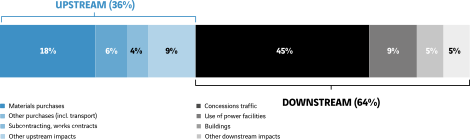
About 87% of upstream emissions, totalling around 16 million tonnes of CO2, come from purchases, primarily construction materials (concrete, steel, bitumen, etc.).
Downstream emissions amount to 28 million tonnes of CO2, of which 16 million tonnes due to traffic on VINCI Autoroutes motorways and 4 million tonnes associated with the landing and take-off (LTO) cycle and passenger access at VINCI Airports as well as road traffic on networks operated by consolidated VINCI Concessions companies. These emissions have been monitored annually for several years and were updated for 2023 (see the table on the following page). The VINCI Highways business scope taken into account for VINCI Concessions was limited to its consolidated concession businesses, corresponding to 0.6 million tonnes of CO2.
CO2 emissions (Scopes 1, 2 and 3 downstream) of VINCI Concessions companies, customers and end users
| non-inclus | VINCI Autoroutes | VINCI Autoroutes | VINCI Airports | VINCI Airports |
|---|---|---|---|---|
| (in tonnes of CO2 equivalent) | 2023(*) | 2022(*) | 2023 | 2022 |
| Market-based Scope 1 and Scope 2 emissions | 17,870  |
18,301 |
81,190 |
71,149 |
| User/third-party emissions (Scope 3) | 15,867,912 |
15,859,378 |
3,223,000(**) |
2,491,150(***) |
(*) User emissions generated by fuel combustion of vehicles on motorways (including upstream fuel).
(**) Downstream Scope 3 downstream emissions for 2023, estimated based on 2022 figures extrapolated from 2023 activity data (number of passenger movements) and actual 023 data (emissions from the landing and take-off cycle) from the first three quarters extrapolated for the entire year.
(***) Downstream Scope 3 emissions for 2022 calculated based on the Airport Carbon Accreditation standard.
Data checked to a level of reasonable assurance.
Other downstream emissions, estimated at about 8 million tonnes of CO2, mainly include emissions associated with the use of equipment installed by VINCI Energies and the use of buildings completed by VINCI Construction.
3.2.3 Resilience of projects and structures
The consequences of climate change affect the Group at the level of its businesses, in both construction and concessions, contracts (such as maintenance contracts), and employees (e.g. site workers). It is therefore a priority for VINCI to further strengthen the resilience of its activities, and it has gained recognised expertise in this area. Resilience is already an integral part of the risk assessment process for the Group’s projects and represents a major area for innovation to safeguard the structures and solutions put in place for customers.