
The chart below shows that the Group’s emissions continue to decline, owing to the measures taken by the various business lines, and particularly the use of renewable energy, but that progress toward achieving the Group’s emissions reduction targets has slowed slightly, with 30% remaining to be achieved by 2030, due to a certain complacency regarding results once the measures have been implemented.
Monitoring VINCI’s progress against its direct emissions reduction target – Performance in 2023
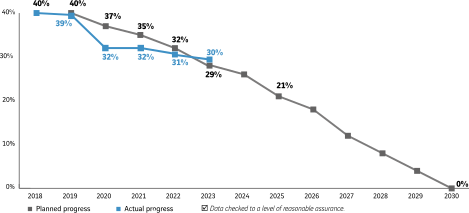
This graph shows the monitoring of VINCI’s progress against its direct emissions reduction target – Performance in 2023
.Planned progress
- 2018: 40%
- 2019: 40%
- 2020: 37%
- 2021: 35%
- 2022: 32%
- 2023: 29%
- 2024: approximately 25%
- 2025: 21%
- 2026: approximately 18%
- 2027: approximately 12%
- 2028: approximately 8%
- 2029: approximately 5%
- 2030: 0%
Actual progress
- 2018: 40%
- 2019: 39%
- 2020: 32%
- 2021: 32%
- 2022: 31%
- 2023: 30%
This 40% reduction target between 2018 and 2030 follows on from the previous environmental commitment from the VINCI Manifesto for the period from 2007 to 2018. This commitment resulted in a 25% reduction in the Group’s emissions between 2009 and 2018, which was expressed in terms of intensity relative to revenue.
3.2.1.3 External recognition
VINCI companies have been implementing ambitious policies to combat climate change for many years. Every year, these policies are reviewed by an independent organisation, CDP (formerly the Carbon Disclosure Project). VINCI achieved a score of A− in 2023, confirming the Group’s efforts to provide transparent information about its climate challenges. This project, which is conducted on behalf of 746 investors representing $136 trillion in assets under management, assesses how large companies are responding to climate change.
Additionally, VINCI Airports is involved in the Airport Carbon Accreditation (ACA) programme to reduce greenhouse gas emissions. This programme launched by Airports Council International (ACI) features seven levels of accreditation. In 2023, four airports in the VINCI Airports network (Toulon Hyères in France; Funchal, Beja and Ponta Delgada in Portugal) reached Level 5, created in 2023, certifying that they have achieved net zero for Scope 1 and 2 emissions and are committed to a plan to reduce Scope 3 emissions. For example, Toulon Hyères airport reduced its Scope 1 and 2 emissions by 92.5% (compared with 2018), by replacing its oil fired boilers with a heat pump and all its lighting with LEDs, by switching to electric runway equipment, by installing a solar canopy to meet 30% of its electricity needs, and by sequestering its residual emissions. The three airports in Portugal cut their Scope 1 and 2 emissions by 97% in 2023 compared with 2018. These airports are also taking concrete steps to influence their Scope 3 emissions, such as supplying aircraft with lowcarbon electricity, applying a system to adjust landing fees based on the aircraft’s CO2 emissions, providing sustainable aviation fuels (SAF), and installing EV charge points in passenger car parks.
| Level of accreditation | Level 1 (Mapping) | Level 2 (Reduction of Scope 1 and 2 emissions) | Level 3 (Optimisation: third-party engagement | Level 3+(Carbon neutrality of Scope 1 and 2 emissions) | Level 4 (Transformation: absolute emissions reduction, and stronger engagements on Scope 3) | Level 4+(Transition: compensate for residual emissions) | Level 5 (Delivering net zero for Scopes 1 and 2, with road map to achieve net zero for Scope 3) |
|---|---|---|---|---|---|---|---|
| Level of accreditation Number of facilities operated by VINCI Airports |
Level 1 (Mapping) 2 |
Level 2 (Reduction of Scope 1 and 2 emissions) 18 |
Level 3 (Optimisation: third-party engagement 14 |
Level 3+(Carbon neutrality of Scope 1 and 2 emissions) 0 |
Level 4 (Transformation: absolute emissions reduction, and stronger engagements on Scope 3) 4 |
Level 4+(Transition: compensate for residual emissions) 10 |
Level 5 (Delivering net zero for Scopes 1 and 2, with road map to achieve net zero for Scope 3) 4 |
In 2023, several airports within the network received the Green Airport Recognition award from Airports Council International Latin America and Caribbean (ACI-LAC):
- OMA (Mexico) was recognised for its innovative projects to optimise the electricity production of its solar farms and their energy storage systems, saving 18 million kWh in four years across its 13 airports.
- Aerodom (Dominican Republic) received the award for its project to optimise the air conditioning system at Las Américas airport in Santo Domingo.
- Concessionária dos Aeroportos da Amazônia (Brazil) was honoured for its sustainable waste management initiative at its seven airports.
- Salvador Bahia airport (Brazil) received special recognition for achieving outstanding performance in the Climate Change Mitigation and Adaptation category for its energy efficiency project, which includes a building management system (BMS), the replacement of obsolete equipment and 100% of light points with LED lamps, a new smart refrigeration system, and a solar power plant that provides 30% of the airport’s required energy.