
Each of VINCI’s business lines has broken down and adapted this target in their environmental policies, adjusting it in line with their specific stakes. As a minimum, the business lines are aligned with the Group’s target of a 40% reduction in emissions for Scopes 1 and 2 (see“ Overview of the main commitments by business line”, page 223). For example, VINCI Concessions has adopted a new target to cut its emissions by 66% from 2018 levels by 2030, having already nearly met its previous target of a 51% reduction in 2023.
3.2.1.1 Actions to reduce direct emissions
| Actions taken in France | Performance indicators | |
|---|---|---|
| Industrial activities | Industrial activities Actions taken in France
|
Industrial activities Performance indicators
|
| Vehicles and site machines | Vehicles and site machines Actions taken in France
|
|
| Buildings and site facilities | Buildings and site facilities Actions taken in France
|
|
| Renewable energy | Renewable energy Actions taken in France– Prioritise the use of renewable energy, especially by installing solar power systems to produce electricity for self-consumption |
Renewable energy Performance indicators– Percentage of renewable energy used |
In 2019, an in-depth analysis was carried out on the measures required to achieve the Group’s Scope 1 and 2 reduction targets for its various activities. This exercise mobilised all of the operational entities, which were able to identify the levers for progress and the related investments needed. Detailed action plans, including financial aspects, have been adopted by all the business lines. VINCI Construction continues to roll out its carbon emissions management tool, NExT, to formulate specific action plans for each company, estimating both the financial advantages and emissions reductions. This tool currently covers 80% of the business line’s GHG emissions and is used in the annual review of strategic business plans to approve investments. Meanwhile, VINCI Airports carefully monitors the decarbonisation of its infrastructure. Targets are revised annually during the budget process, in particular thanks to the Smart Data Hub systems in place at the airports, which they use to design and implement their own decarbonisation plans. However, the achievement of the target for a 40% reduction by 2030 will require further technological advances that are under development, which means that there is still some uncertainty as to when they will be completed.In 2023, the implementation of these action plans continued in the four priority areas for action: the environmental performance of site machinery and heavy vehicles, the mobility of VINCI employees, the energy optimisation of industrial processes and buildings, and the decarbonisation of energy used.
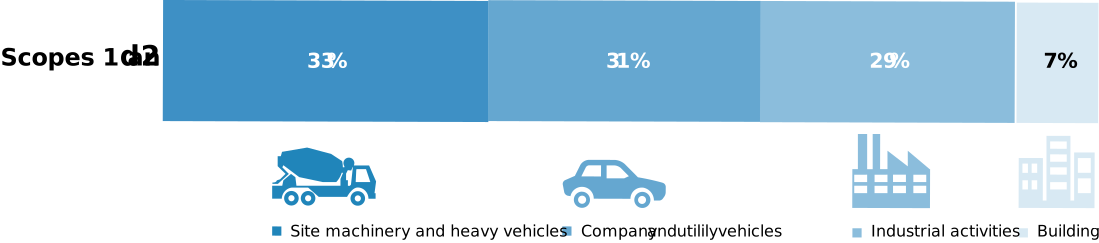
Environmental performance of site machinery and heavy vehicles
The consumption of energy relating to the use of site machinery and heavy vehicles is the primary source of Scope 1 and 2 emissions for VINCI, representing 33% of total emissions. To reduce the corresponding emissions, VINCI entities are working with their suppliers to take action in three key areas: monitoring consumption in real time, providing training for operators and modernising their fleets. To monitor its consumption, VINCI Construction continues to roll out e Track, which captures data for machines, trucks and utility vehicles fitted with telematics systems, with a view to optimising their use and therefore their energy consumption. This tool was operational for more than half of the VINCI Construction fleet in 2023.
VINCI is also investing in modernising its fleet of vehicles and trucks. Although the large scale electrification of construction vehicles remains limited, testing is growing:
- In July 2023, VINCI Construction collaborated with the Fayat Group to carry out the first roadworks project using 100% electric equipment to resurface the Rue du Lieutenant PetitLeroy in Chevilly Larue outside Paris.
- Toulon Hyères airport introduced a 100% electric refuelling truck to distribute sustainable aviation fuel (SAF). Eight electric platform lifts (ambulifts) are in operation at ANA airports in Portugal to help reduced mobility passengers with boarding and disembarking.