
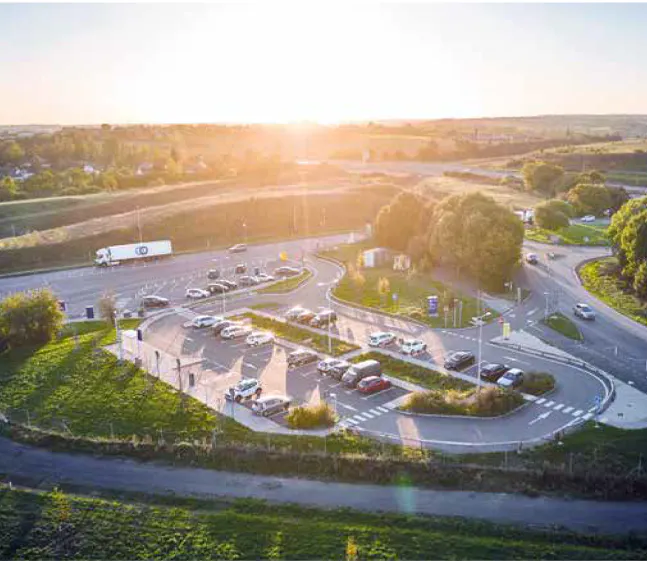
1 Carpool car parks, like this one near Laval on the A81 in western France, are part of the motorway transformation and decarbonisation plan.
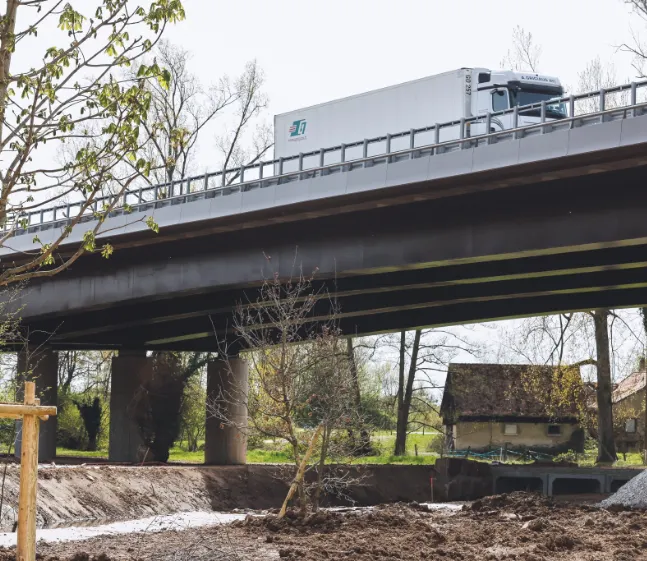
2 Landscaping works during construction of the A355 in Alsace, eastern France.
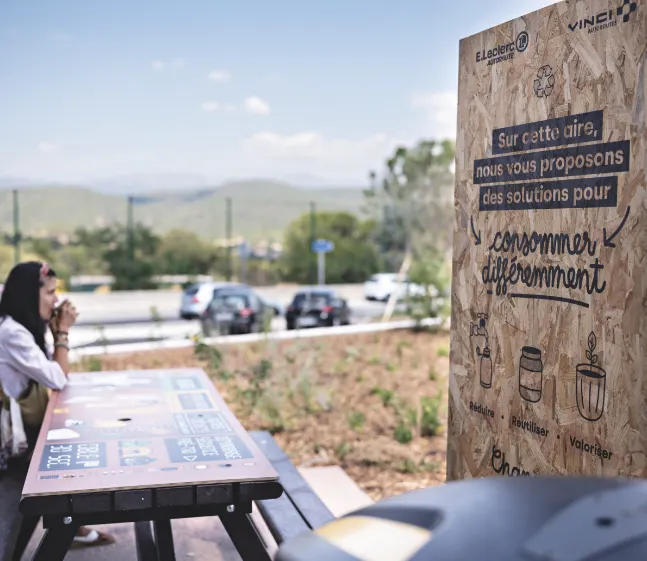
3After substantial refurbishment, the redeveloped Estérel service area on the A8 in southern France reopened in 2022 as a pilot “zero waste” site.
In its own operations, VINCI Autoroutes aims to recycle or reuse all the waste generated by its activities in 2025 (84% in 2022) either as raw materials or as energy. To achieve this, it sets up recycling systems for each type of waste. For example, it recycles all its traffic cones. Working with service area commercial facilities on solutions that avoid producing waste at source, VINCI Autoroutes launched the “zero waste” initiative in 2022. During the summer holiday period, the VINCI Autoroutes Foundation ran another anti-littering campaign urging users to stop throwing rubbish out of their car windows – something around one in four road users does. As well as raising awareness of the need for responsible, eco-friendly behaviour, VINCI Autoroutes has simplified signage at its service area waste sorting points, making the instructions easier to understand for travellers of all nationalities.
Towards land rehabilitation of motorway areas
VINCI Autoroutes maintains more than 28,000 hectares of green spaces which can be used for ecological regeneration programmes, for example to plant trees, p reserve natural environments or restore wetlands. To establish a long-term scientific framework for this kind of operation, in February 2022, VINCI Autoroutes signed a partnership with the Office National des Forêts, France’s National Forest Office, or ONF. VINCI Autoroutes will conduct 200 land rehabilitation projects on its network by 2030, based on studies carried out by the ONF to identify appropriate sites. These green spaces will be rehabilitated following the ONF’s recommended specifications, which include the selection of plant species and maintenance tools and methods. The first projects carried out as part of this programme included planting trees at the Brétinière and Herbiers sites on the A87 in north-west France, and prioritised local species adapted to the region’s north Atlantic coastal climate.
VINCI Autoroutes has introduced methods for the maintenance of its green areas that are more respectful of natural environments.It has eliminated nearly all phytosanitary products and only mows verges where absolutely necessary. It has rolled out a green area management plan at most of its sites that allows bio-diversity to flourish with as little human intervention as possible.
VINCI Autoroutes landscape projects also include a commitment to sustainable maintenance from the design stage – choosing suitable plant species, using biodegradable mulch, creating drought- tolerant green areas, etc. VINCI Autoroutes has also made efforts to conserve water resources by installing dry urinals at its rest areas. It has partnered with the startup Toopi® Organics to collect the urine and reuse it as fertiliser in local farming.