
4.4.1 Mapping of the Group’s major risks
a. Identification of VINCI’s material issues
In 2017, the Group established a risk map, which it updated in 2019, working with an outside provider to ensure a thorough assessment using valid methodology. The mapping involved an analysis of the vulnerability of the Group’s activities to the physical risks associated with extreme weather events looking ahead to 2050, performed by the engineering and design office Resallience using data from the RCP 4.5 scenario in the Fifth Assessment Report of the Intergovernmental Panel on Climate Change (IPCC). In collaboration with the environmental managers of VINCI companies, the risks for their main operational business activities were mapped in the following manner:
- identification of about 15 inherent environmental risks, based on a materiality assessment, industry knowledge and complementary bibliographical research;
- rating by the business lines’ environmental managers against three criteria: severity, probability of occurrence and degree of control (based on existing governance, processes and tools to manage the risks);
- summary of inherent and residual environmental risks at Group and business line levels.
To identify the material environmental issues for the Group’s activities, in addition to the mapping of physical risks associated with extreme weather events, a broader analysis of main environmental risks for each business activity was performed. As a result of this risk assessment for each of the 15 business activities, specific action plans for each risk were developed. The geographical factor was also taken into account; main environmental risks were identified for each country where the Group is present. The reported index is the average of nine environmental indicators: biodiversity and protection of marine areas, biodiversity and protection of land areas, exposure to climate change, vulnerability to climate change, deforestation, environmental regulatory framework, waste management, water pollution and water depletion. VINCI also produced a map positioning its countries of operation based on local environmental regulations.
In 2022 this assessment was expanded to encompass the principle of “double materiality”. This concept distinguishes between financial materiality, which considers how environmental risks could affect the Group’s financial performance, and impact materiality, which considers how the Group’s activities could impact their environment. Impact materiality is assessed through interviews conducted with the Group’s environmental experts, applying the same approach as VINCI’s existing risk analysis procedures (see chapter D, “Risk factors and management procedures”, page 179).
These analyses served to identify the main risks for the Group’s activities, as well as the different risk management strategies available and their suitability.
b. VINCI’s material issues
The material environmental issues on which the activities of VINCI companies may have a significant impact were sorted into three categories. The categories span the entire project life cycle, from the response to the call for tenders to the preparation of sites and construction, through to the operating phase. Subcontractors and suppliers are also taken into account.
To identify the residual risks mapped below, gross risks were assessed according to their severity and probability of occurrence for the Group, which was reduced in proportion to the level of management of the risk. These risks were plotted according to their time horizon: short-term (less than five years) or medium/long-term (more than five years).
Climate risks were assessed from the perspective of two scenarios in Working Group 1’s Fifth Assessment Report of the IPCC: the RCP 2.6 (an “optimistic” scenario with a high probability of limiting the global temperature rise to 2.5°C by the end of the century) and the RCP 4.5 (a “realistic” scenario more likely than not to result in a global temperature rise as high as 3.3°C by the end of the century).
Environmental risk map
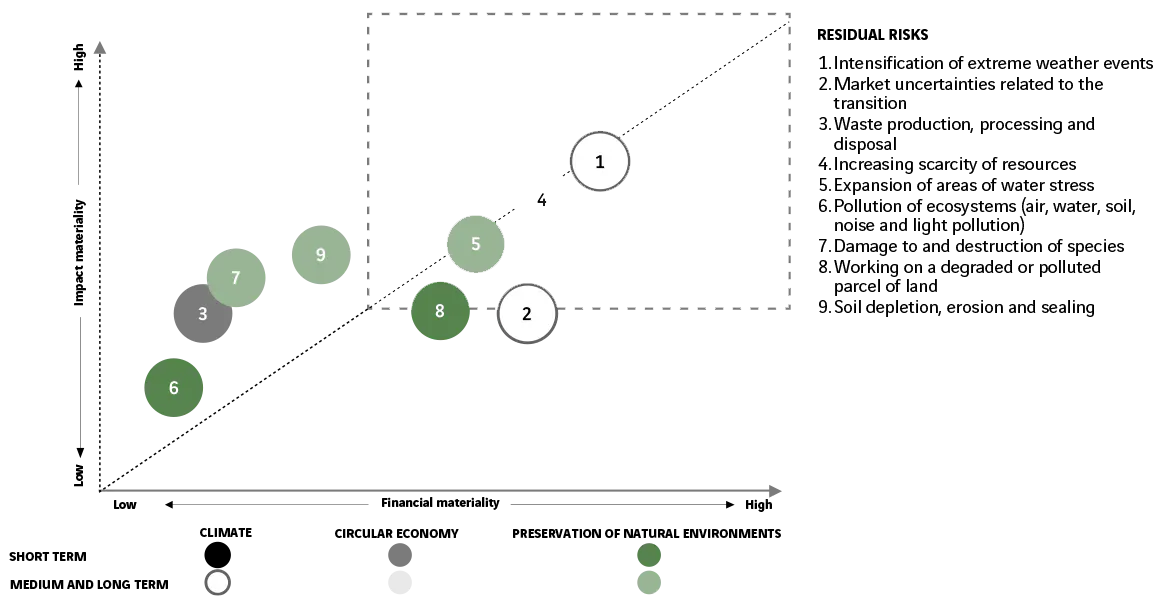
This map shows the Environmental risk map.
Climate :
- 1. Intensification of extreme weather events, medium and long term effect
- Financial materiality: high high
- Impact materiality: high 2. Market uncertainties related to the transition, medium and long term effect
- Financial materiality: medium
- Impact materiality: medium
Circular economy:
- 3. Waste production, processing and disposal, short term effect
- Financial materiality: low
- Impact materiality: medium
- 4. Increasing scarcity of resources, medium and long term effect
- Financial materiality: high
- Impact materiality: medium
Preservation of natural environments:
- 5. Expansion of areas of water stress, medium and long term effect
- Financial materiality: medium
- Impact materiality: medium
- 6. Pollution of ecosystems (air, water, soil, noise and light pollution), short term effect
- Financial materiality: low
- Impact materiality: low
- 7. Damage to and destruction of species, medium and long term effect
- Financial materiality: low
- Impact materiality: medium
- 8. Working on a degraded or polluted parcel of land, short term effect
- Financial materiality: medium
- Impact materiality: medium
- 9. Soil depletion, erosion and sealing, medium and long term effect
- Financial materiality: low
- Impact materiality: medium