
Net zero emissions as a service to our customers
Net Zero Initiative guidelines specify three ways companies can contribute to carbon neutrality: reducing their own emissions, reducing their customers’ emissions and contributing to increasing the use of carbon sinks. In anticipation of requests, some VINCI companies have gotten involved in developing carbon sinks that customers can use as a complement to measures they take to reduce emissions. In 2022, VINCI Airports signed a partnership with Néosylva to invest in projects on private forest land, which includes most of France’s forest land surface. The aim is to promote forest regeneration by managing the forest parcels to be renewed and by providing expertise and part of the financing needed for ecological improvement works. As a result, 150 hectares of damaged forest will be restored over a period of 30 years in the Brittany, Pays de la Loire and Auvergne-Rhône-Alpes regions. Between 2018 and 2021, Lima Expresa (a VINCI Highways subsidiary) reduced its direct emissions by approximately 30% through the implementation of an energy efficiency and decarbonisation plan (LED technologies, electric vehicles, renewable electricity supply, etc.). The company also contributes to sequestering its residual emissions and was awarded the fourth star in the Carbon Footprint Peru programme by the Peruvian Ministry of the Environment. In 2022, the Lima Expresa motorway financed a REDD+ (Reducing Emissions from Deforestation and Forest Degradation) project in the Tambopata-Bahuaja national reserve and park maintaining a carbon sink that sequesters 721 tonnes of carbon. This project is certified to the Verified Carbon Standard and the Climate, Community and Biodiversity (CCB) Standards, the latter at Double Gold Level (Climate and Biodiversity). VINCI Energies now offers Green Edge, an internal solution developed in Sweden that automates data collection and uses internet of things (IoT) sensors to measure the footprint in CO₂ equivalent. The tool can then be used to manage an action plan and a carbon budget.
3.2.2.2 Monitoring performance
- Scope 3
Overview of VINCI Scope 3 in 2019 (baseline year)
In 2019, VINCI’s indirect emissions (Scope 3) totalled approximately 42 million tonnes of CO₂ (adjusted for acquisitions and disposals having occurred since 2019). This level was maintained in 2022, following the consolidation of Scope 3 reporting data. In this figure, upstream emissions account for 40% and downstream emissions 60%. Two GHG Protocol categories alone account for nearly 90% of emissions: purchases of goods and services and the use of built, operated and maintained infrastructure.
Work in 2022 and 2030 target
In 2022, VINCI defined operational action plans and implemented reporting processes for monitoring and reducing Scope 3 emissions, in line with commitments made in 2021 (see paragraph 3.2.2, “Reducing the Group’s indirect emissions (Scope 3)”, page 234).
Scope 3 emissions by category at 31 December 2022
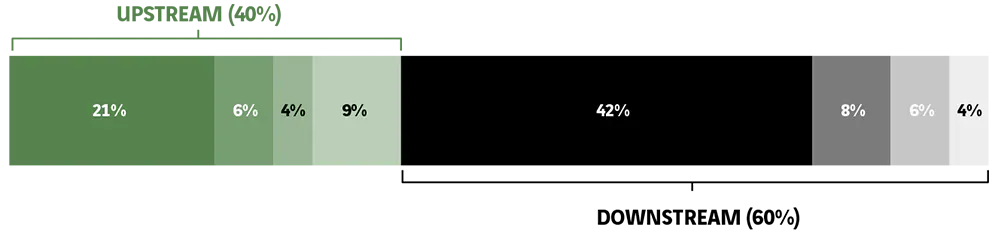
This diagram shows the Scope 3 emissions by category at 31 December 2022
Upstream (40%)
Materials purchases: 21%
Other purchases (incl. transport): 6%
Subcontracting, works contracts: 4%
Other upstream impacts: 9 %
Downstream (60%)
Concessions traffic: 42%
Use of power facilities: 8%
Buildings: 6%
Other downstream impacts: 4%
About 85% of upstream emissions, totalling around 17 million tonnes of CO₂, come from purchases, primarily construction materials (concrete, steel, facilities, effic.).
Downstream emissions amount to 25 million tonnes of CO₂, of which 15.9 million tonnes due to traffic on VINCI Autoroutes motorways and 1.2 million tonnes associated with the landing and take-off (LTO) cycle and passenger access at VINCI Airports as well as road traffic on networks operated by consolidated VINCI Concessions companies. These emissions have been monitored annually for several years and were updated for 2022 (see the table on the following page). The VINCI Highways business scope taken into account for VINCI Concessions was limited to its consolidated concession businesses. These emissions amount to 0.2 million tonnes of CO₂, and were calculated by a specialised consulting firm for the following scope: Lima Expresa (Peru) and Gefyra (Greece).
Other downstream emissions, estimated at about 7.9 million tonnes of CO₂, mainly include emissions associated with the use of equipment installed by VINCI Energies and the use of buildings completed by VINCI Construction.