
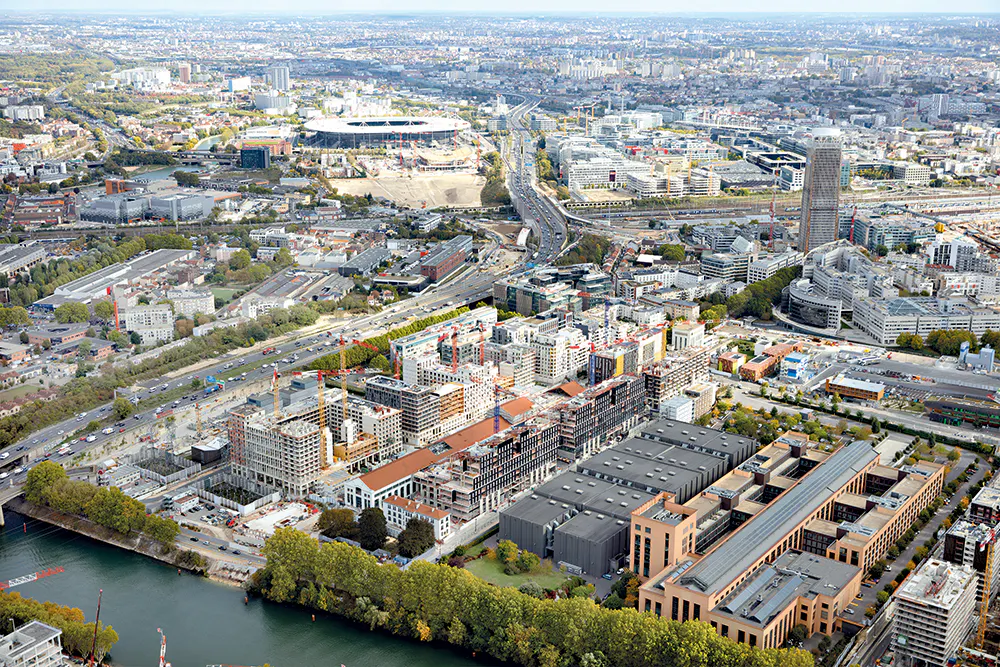
Universeine will be part of the athletes’ village for the world’s largest sports event in 2024. After the event, the complex will be transformed into a large mixed-use district that shows the way for environmentally friendly city planning.
The project also showcases VINCI Immobilier’s strategy for land recycling, combined with the expertise of VINCI Construction and VINCI Energies in low-carbon buildings, energy efficiency and the circular economy.
In this context of climate emergency, the environment is VINCI’s strategic priority. The Group is tackling this issue by playing an active role in the transition of the built environment, infrastructure and mobility.
VINCI has recast its environmental policy and, in 2020, it laid out a new road map for the coming decade. The Group has committed to reducing its business activities’ direct CO₂ emissions by 40% by 2030 (baseline year of 2018), on a trajectory that should help it contribute to global carbon neutrality in 2050. It has also pledged to achieve a 20% reduction in indirect upstream and downstream emissions (Scope 3) by 2030 (baseline year of 2019). In addition, the Group has made deep commitments to support a circular economy and preserve natural environments (see page 220 and below). The road map calls for action plans by each business line and strong employee engagement to put the Group’s collective commitment into action through local initiatives. VINCI welcomes the ecological transition as a powerful lever for the renewal of its expertise and solutions and a long-term driver of growth for its business activities. The Group’s policy of innovation is building opportunities in this transformation. As novel solutions and services emerge that create environmental value, promising activities open up for the Group’s business lines.