
Low-carbon mobility
Alongside efforts to reduce the carbon footprint of motorway works and operations, VINCI Autoroutes is taking steps to decarbonise motorway usage (down-stream Scope 3), an essential focus as road mobility continues to account for over 90% of emissions from transport in France. Given their scale, motorways have a leading role to play in decarbonising road travel.
Light vehicles and long-distance electric mobility
Since 2023, all the service areas across the VINCI Autoroutes network have been fitted with charging stations for electric vehicles. At end-2025, over 2,400 charge points were in operation network-wide, 88% of which are capable of delivering a full charge in around 30 minutes. This coverage makes long-distance electric mobility easier by providing users with sufficient access to charging infrastructure. In 2025, nearly 3 million charging sessions were recorded across the VINCI Autoroutes network, up over 50% on 2024. Electric car valets, also known as “blue vest” staff, were once again deployed at service areas in its network to provide user assistance and more effectively manage charging stations during high traffic peaks. To increase network density, VINCI Autoroutes is working on extending electric infrastructure to all its service areas. At end-2025, 38 service areas were equipped, offering 399 charge points. Expected medium- to long-term growth in the number of light electric vehicles (currently at 3.7% of vehicles, this figure is predicted to grow to 15% by 2030 and 37% in 2035) means the number of accessible charge points will have to increase approximately sevenfold to service demand during peak traffic periods.
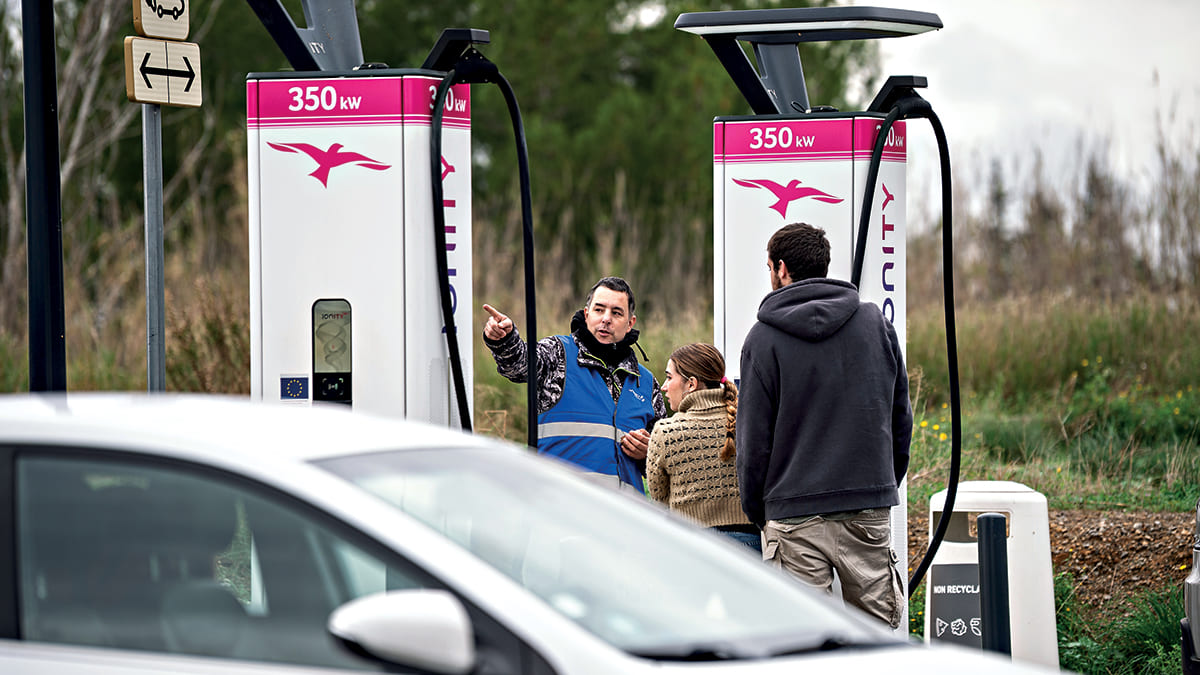
VINCI Autoroutes has the motorway network with the highest EV charging density in Europe, with 55 charge points per 100 km.
Electrification of heavy vehicles and innovation
Four electric charging stations for heavy vehicles were opened in 2025. A study jointly conducted by VINCI Autoroutes, TotalEnergies, Enedis and six European car manufacturers found that demand for charging while in transit on the main road corridors in France could reach around 3.5 TWh per year by 2035 (“Electrification of the long-distance heavy duty vehicle fleet”, study published in March 2024). To handle the number of electric heavy vehicles, which is predicted to account for 30% of the fleet by that date, nearly 12,000 special charge points will have to be installed along the French road network. In addition to in-transit charging at fixed points, dynamic charging transfers power wirelessly to heavy vehicles while driving. This technology could reduce the size of batteries while eliminating range constraints. Solutions of this nature are being trialled via the Charge As You Drive project, launched in 2023 by a consortium led by VINCI Autoroutes, involving in particular VINCI Construction, as part of a Bpifrance call for projects. The project, a world first, is currently testing dynamic wireless charging on a motorway. On 22 October 2025, during the first real-world trial, an electric heavy vehicle was able to charge while driving along the A10 motorway in Angervilliers, south-west of Paris. Electricity was delivered by 900 copper coils installed beneath the road surface by VINCI Construction’s Road France division, generating an electromagnetic field capable of transferring energy to vehicles equipped with receiver coils. Four prototypes (a heavy vehicle, a bus, a car and a utility vehicle) are now driving along a 1.5 km pilot stretch to test this new charging technology. As such, the A10 has become the world’s first motorway to offer dynamic induction charging.
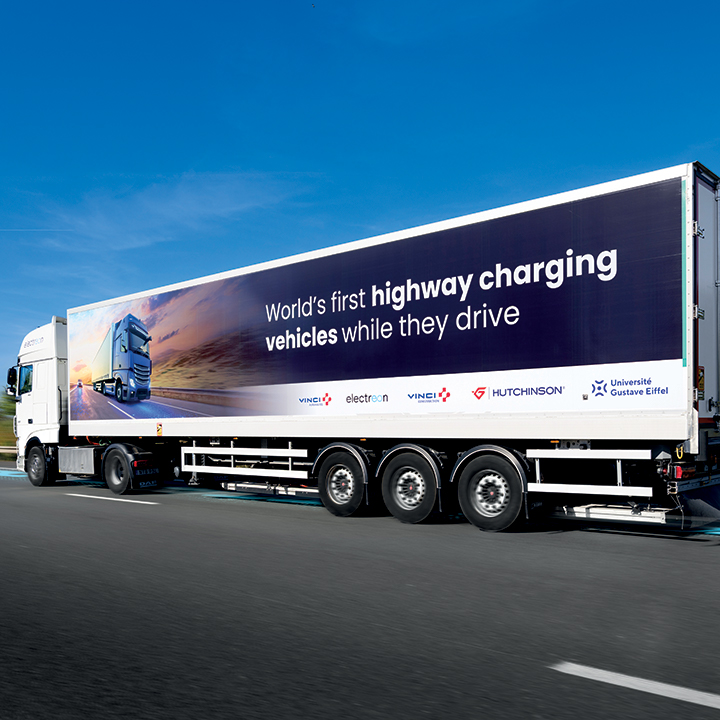
Road tests in real traffic conditions were conducted for the world’s first dynamic induction charging motorway.
12,000special charge points will need to be installed across France’s motorway network by 2035 if 30% of heavy vehicles are powered by electric batteries.