
Edinburgh airport achieved ACA Level 4+ by rolling out various initiatives, including the commissioning of a 9.7 MWp solar farm and use of alternative fuels (HVO) for operational vehicles.
Less than two years after achieving ACA Level 2, Belgrade airport reached ACA 3 certification through energy efficiency measures that involved replacing 95% of traditional lighting systems with LED technology and electrifying its ground operations.
At Funchal airport in Madeira, micro wind turbines and a 1.5 MWp solar farm were installed to power airport equipment, as part of its goal to achieve energy self-sufficiency.
All in all, at end-2025, 44 solar power plants were in operation across the network’s airports for a total installed capacity of 82 MWp, enough to power airport infrastructure directly and feed excess energy into the grid, thereby contributing to the energy transition of the surrounding regions.
With 66 accredited airports in all, of which six – located in France, Portugal and Brazil – have achieved top-level accreditation (Level 5), VINCI Airports is the leading contributor worldwide to the ACA programme.
VINCI Airports continues its efforts to facilitate access to sustainable aviation fuels (SAF).
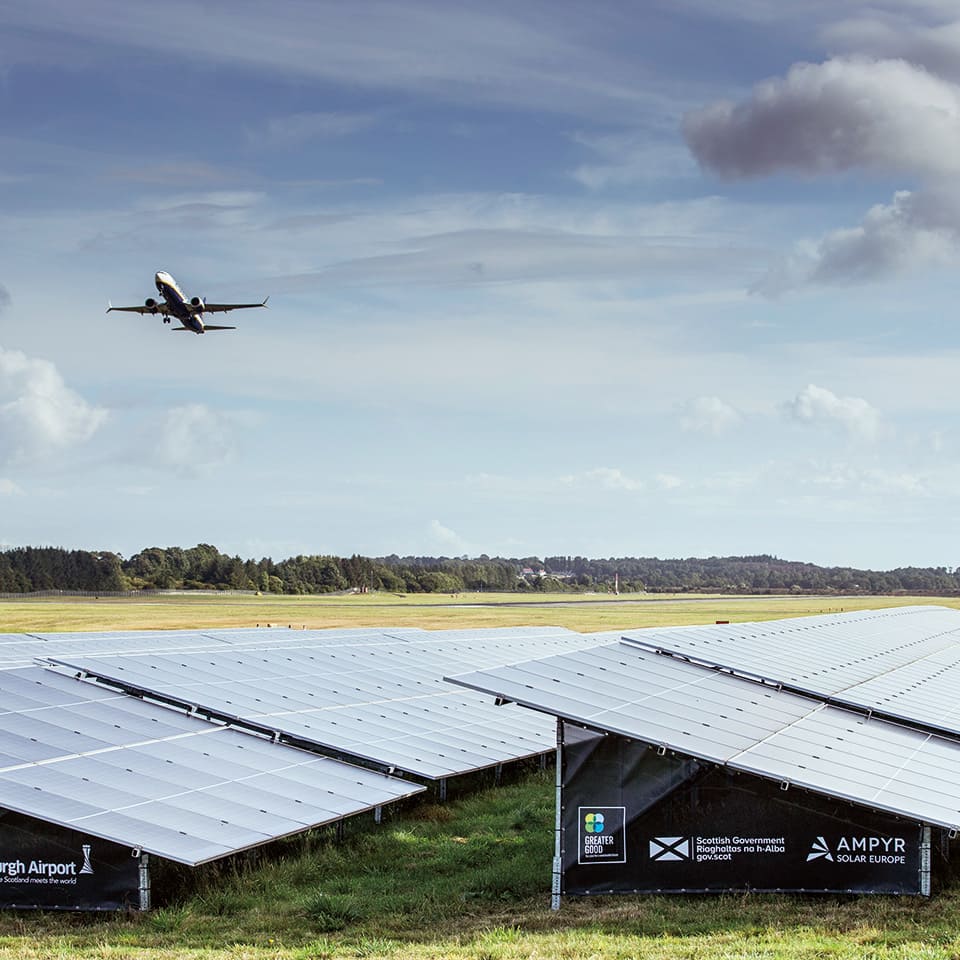
A 9.7 MWp solar farm was brought into service at Edinburgh airport.
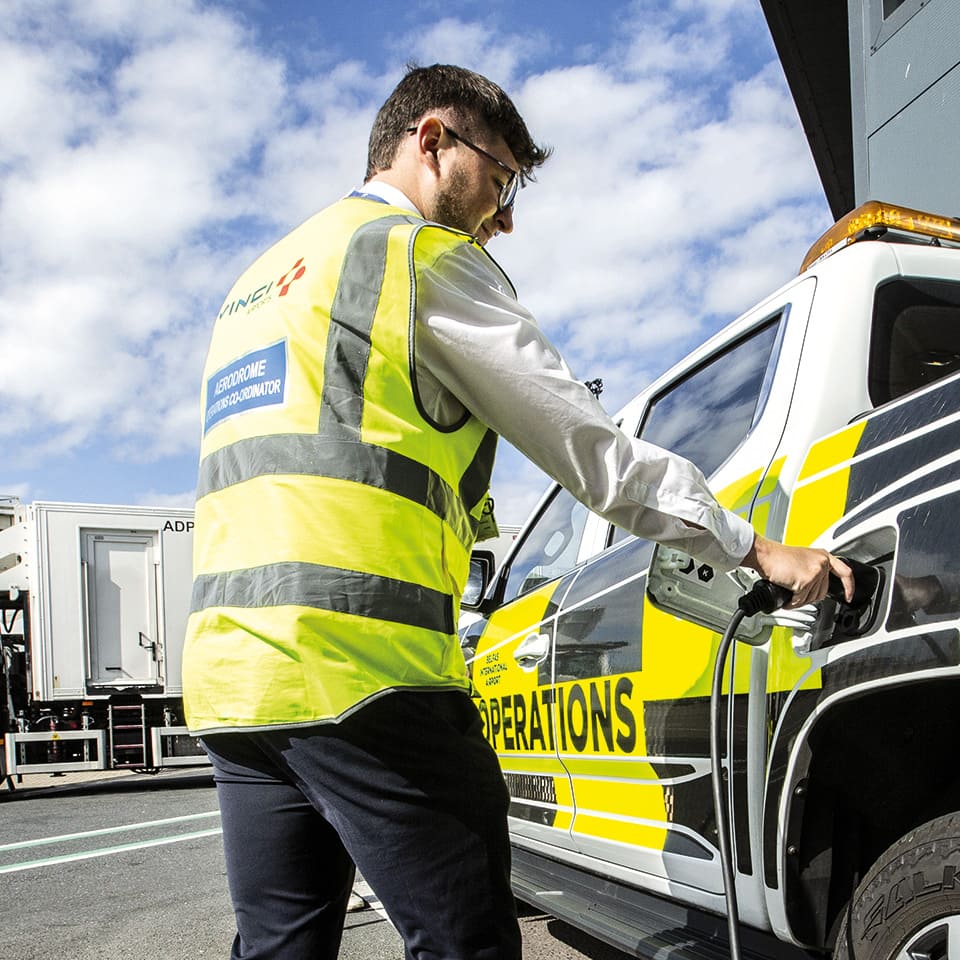
Service vehicles at Belfast airport are now electric-powered.
In 2025, Salvador Bahia moved towards decarbonisation of aviation in Brazil as the country’s first airport to offer these new fuels for commercial operations. In July 2025, Lyon-Saint Exupéry inaugurated the HYmpulsion station serving light vehicles (the first hydrogen distribution station at a French airport). In April, it unveiled an educational display aimed at raising passengers’ awareness of sustainable mobility.
On a more long-term view, VINCI Airports collaborates with industrial players in its sector to develop the use of clean hydrogen in aviation. After a partnership bringing together Airbus and the London Gatwick, Lyon-Saint Exupéry and Kansai International airports in 2024, VINCI Airports signed an agreement with H2V and Hy2gen in January 2025 to study methods to produce and supply synthetic sustainable aviation fuels, or e-SAF, intended for commercial airlines operating at Lyon-Saint Exupéry,Lyon Bron and Clermont-Ferrand Auvergne by 2030. Developed from low-carbon hydrogen, these e-SAFs will be produced on the site of the consortium formed between H2V and Hy2gen (southern France).