
This system can be accessed via the Group’s intranet or its website and offers (i) an online platform available worldwide 24/7, (ii) a dedicated email address, and (iii) a mailing address. The online platform, called VINCI Integrity, can be used to report incidents safely and anonymously. The aim is to ensure that this internal reporting system remains available to all Group employees and all of its stakeholders.
The whistleblowing reporting and processing procedure, available on the Group’s intranet, defines how the whistleblowing process works. It is supplemented by a practical guide to internal investigations to be used by those responsible for conducting such investigations.
This procedure guarantees the confidentiality of the information collected in the context of a whistleblowing report, especially the identity of the whistleblower and of any other persons involved.
It also ensures that investigations are handled in accordance with France’s whistleblower protection legislation, and specifically Law 2022-401 of 21 March 2022, known as the Waserman law. This legislation applies to the Group, setting out the requirements for internal investigations in terms of time frames, independence and impartiality.
The governance of internal reports is coordinated by a whistleblowing committee, which collects, analyses and processes whistleblowing reports, and an investigation committee, which conducts the internal investigations. In some instances, the whistleblowing committee may propose sanctions or remediation measures for the manager at the appropriate organisational level.
The whistleblowing reporting and processing procedure also sets out how the Group receives anonymous summaries of whistleblowing reports and any subsequent action taken.
The key employees involved in collecting and processing whistleblowing reports have received training, especially on obligations involving whistleblower protection and the confidentiality of all communications received.
Whistleblower protection
The Group pledges to protect whistleblowers and facilitators from any form of retaliation, including threats and attempts of retaliation, and to provide the persons concerned with the protection measures specified for France in Law 2016-1691 of 9 December 2016 and in Directive (EU) 2019/1937 of the European Parliament and of the Council of 23 October 2019 on the protection of persons who report breaches of Union law. These whistleblower protection measures are included in the FAQ on the VINCI Integrity platform.
4.3 Prevention and detection of corruption and bribery - Incidents of corruption or bribery
The Group has implemented a robust anti-corruption system with measures for identifying and handling risks of corruption and influence peddling.
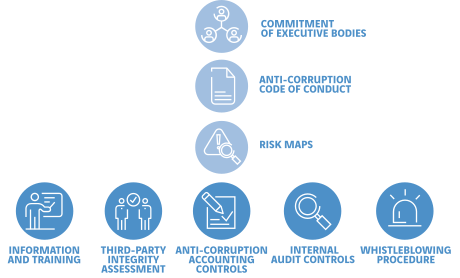
This diagram presents the eight pillars of the VINCI Group’s anti-corruption framework, organized into two levels.
Upper level — three foundational pillars:
- Commitment of the governing body
- Anti-corruption code of conduct
- Corruption risk mapping
Lower level — five operational pillars:
- Information and training
- Third-party integrity assessment
- Anti-corruption accounting controls
- Internal audit controls
- Whistleblowing system
In line with the Group’s decentralised governance structure, VINCI’s Executive Management stipulates in its general guidelines that operational members of the Executive Committee are required to implement measures adapted to their respective business sectors for detecting potential acts of corruption and influence peddling.