
Greenhouse gas emissions reduction levers – Scope 3
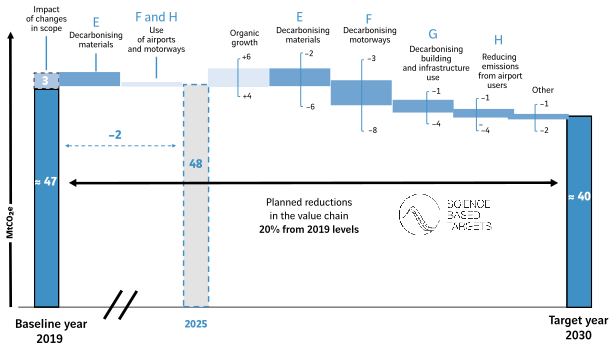
This chart shows the Greenhouse gas emissions reduction levers – Scope 3 of the VINCI group, in MtCO2e, between baseline year 2019, the 2025 financial year and target year 2030.
In 2019, baseline emissions stood at approximately 47 MtCO2e. The impact of changes in scope is -2, with 3 MtCO2e of additional emissions identified, bringing the level to 48 MtCO2e at the 2025 financial year.
The planned reduction levers to reach target year 2030 are as follows:
E — Decarbonising materials: -2, then -6.
F and H — Use of airports and motorways: +6, then +4.
E — Organic growth: -2.
F — Decarbonising motorways: -3, then -8.
G — Decarbonising building and infrastructure use: -1, then -4.
H — Reducing emissions from airport users: -1, then -4.
Other: -1, then -2.
The target in 2030 is approximately 40 MtCO2e, representing planned reductions in the value chain of 20% from 2019 levels, validated by Science Based Targets initiative.
The method used by the Group to re-estimate baseline year emissions, in accordance with its SBTi commitment, is described in the methodology note, page 288. For each emissions reduction lever, the Group has identified the potential range of (positive or negative) impact. However, thanks to the combined use of all levers, the Group’s ability to achieve its overall reduction target is not jeopardised.
VINCI’s approach to its Scope 1, 2 and 3 GHG reduction commitments is focused on achieving impactful results. Although the Group has defined clear targets for 2030 for some key actions, its strategy is a flexible one that allows for adjustments to be made based on operational realities. Its portfolio of initiatives combines effective reduction measures with substitution solutions. The mix aims to maximise total impact while taking into consideration local circumstances and opportunities that are specific to each region. The transition plan progress made in 2025 is described in paragraph 2.2.3.2, “GHG emissions”, page 224.
| Ref. | Scope | Reduction lever | Actions | Benchmark report or sector pathway to 2030 | |
|---|---|---|---|---|---|
Ref. A. |
Scope Own operations |
Scope 1 |
Reduction lever Employee mobility |
Actions
|
Benchmark report or sector pathway to 2030
|
Ref. B. |
Scope Own operations |
Scope 1 |
Reduction lever
|
Actions
|
Benchmark report or sector pathway to 2030
|
Ref. C. |
Scope Own operations |
Scopes 1 and 2 |
Reduction lever Optimising energy for industrial activities and buildings |
Actions
|
Benchmark report or sector pathway to 2030
|
Ref. D. |
Scope Own operations |
Scope 2 |
Reduction lever Decarbonising the energy mix |
Actions
|
Benchmark report or sector pathway to 2030
|
Ref. E. |
Scope Value chain |
Scope 3 |
Reduction lever Decarbonising materials |
Actions
|
Benchmark report or sector pathway to 2030 Emissions reduction of at least 20% by cement manufacturers in France (*) |
Ref. F. |
Scope Value chain |
Scope 3 |
Reduction lever Decarbonising motorways |
Actions
|
Benchmark report or sector pathway to 2030 Electrification of the light vehicle fleet and energy performance improvements for heavy vehicles (under France’s National Low-Carbon Strategy) |
Ref. G. |
Scope Value chain |
Scope 3 |
Reduction lever Decarbonising building and infrastructure use |
Actions
|
Benchmark report or sector pathway to 2030 Decrease total life-cycle emissions from buildings (RE2020) by 30% |
Ref. H. |
Scope Value chain |
Scope 3 |
Reduction lever Reducing emissions from airport users |
Actions
|
Benchmark report or sector pathway to 2030
|