
These commitments were also certified in February 2022 by the SBTi, aligning the Group’s emissions reduction with the well below 2°C goal, and will be revised at least every five years, in accordance with SBTi guidance. The two baseline years are the most recent periods for which the available data is sufficiently reliable to serve as the basis for target-setting. VINCI’s targets correspond to a level of ambition that was approved by the SBTi at the time the Group’s commitment was made, in 2022. As alignment with the 1.5°C goal is not an obligation and the Paris Agreement does not apply at the level of an individual business organisation, VINCI chose to set ambitious but realistic objectives. Moreover, the nature of the Group’s activities does not exclude VINCI from Paris-aligned benchmarks.
Each of VINCI’s business lines has incorporated the Group’s emissions reduction commitments into their environmental policies, while adjusting them to address their specific situations. As a minimum, all business lines are aligned with the Group’s target of a 40% reduction in emissions for Scope 1 and market-based Scope 2. Some have chosen to go even further. By 2023, VINCI Concessions had already reached its initial target: a 50% reduction in Scope 1 and market-based Scope 2 emissions by 2030 from 2018 levels. The business line therefore reset its goal to 66%, to be achieved over the same period. In 2024, this target was raised again, to 67%, to align with other motorway activities in France. In 2024, VINCI Autoroutes also revised its target, moving from a 50% reduction of Scope 1 and location-based Scope 2 emissions to a 67% reduction of Scope 1 and market-based Scope 2 emissions by 2030.
The Group has identified key areas for reducing direct emissions (Scopes 1 and 2) and indirect emissions (Scope 3). In these areas, its own initiatives combine with those of external stakeholders involved in the decarbonisation of its value chain. VINCI strives to accelerate these external efforts and strengthen its role as a driver of the low-carbon transition. Scope 3 emissions reduction will remain largely dependent on external factors, such as the electrification of mobility infrastructure and the decarbonisation of building materials and energy equipment. The Group does not foresee any significant risks, impacts or opportunities resulting from the implementation of the climate transition plan that would affect ecosystem preservation or social issues.
The Board of Directors reviews the climate transition plan and progress made annually, at the same time it validates the Group’s sustainability report. The effective implementation of the transition plan hinges on the engagement of VINCI’s Executive Committee, on which the Group’s business lines and Environment Department are all represented.
In addition to these absolute targets for 2030, VINCI aims to contribute to global net zero by 2050. However, the Group has not yet set a quantified and certified target for this deadline.
Greenhouse gas emissions reduction levers – Scope 1 and market-based Scope 2
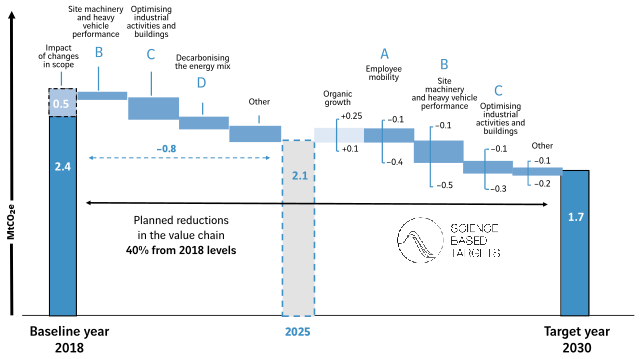
This chart shows the Greenhouse gas emissions reduction levers – Scope 1 and market-based Scope 2 of the VINCI Group, in MtCO2e, between baseline year 2018, the 2025 financial year and target year 2030.
In 2018, baseline emissions stood at 2.4 MtCO2e. The impact of changes in scope is +0.5, with a cumulative reduction of -0.8 bringing the level to 2.1 MtCO2e at the 2025 financial year.
The reduction levers applied between 2018 and 2025 are as follows:
B — Site machinery and heavy vehicle performance,
C — Optimising industrial activities and buildings,
D — Decarbonising the energy mix,
Other: reduction.
The planned reduction levers to reach target year 2030 are as follows:
Organic growth: +0.25, then +0.1.
A — Employee mobility: -0.4.
B — Site machinery and heavy vehicle performance: -0.1, then -0.5.
C — Optimising industrial activities and buildings: -0.1, then -0.3.
Other: -0.1, then -0.2.
The target in 2030 is 1.7 MtCO2e, representing planned reductions in the value chain of 40% from 2018 levels, validated by Science Based Targets initiative.