
The other parties involved in the overall governance of sustainability issues, in this second year of reporting under the CSRD, are presented below:
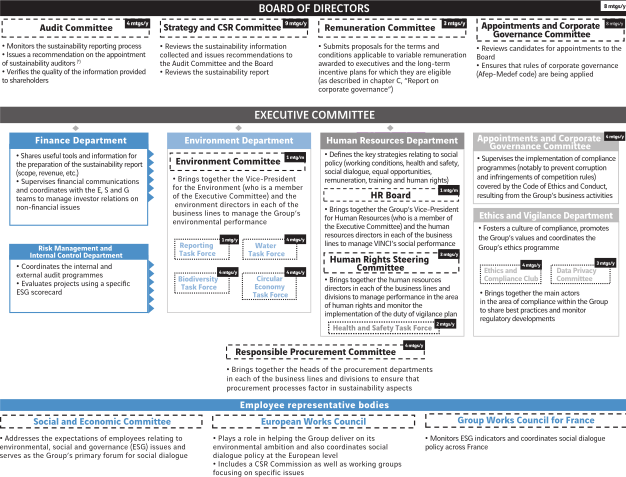
BOARD OF DIRECTORS 8 mtgs/y
Audit Committee 4 mtgs/y
- Monitors the sustainability reporting process and issues recommendations on the appointment of sustainability auditors (*)
- Verifies the quality of the information provided to shareholders
Strategy and CSR Committee 9 mtgs/y
- Reviews the sustainability information collected
- Issues recommendations to the Audit Committee and the Board
- Reviews the sustainability report
Remuneration Committee 3 mtgs/y
Submits proposals for the terms and conditions applicable to variable remuneration awarded to executives and long-term incentive plans (as described in chapter C, “Report on corporate governance”)
Appointments and Corporate Governance Committee 8 mtgs/y
- Reviews candidates for appointments to the Board
- Ensures that corporate governance rules (Afep-Medef code) are applied
EXECUTIVE COMMITTEE
Finance Department
- Shares tools and information for preparing the sustainability report (scope, revenue, etc.)
- Supervises financial communications
- Coordinates with ESG teams to manage investor relations on non-financial issues
Risk Management and Internal Control Department
- Coordinates internal and external audit programmes
- Evaluates projects using a specific ESG scorecard
Environment Department
Environment Committee 1 mtg/m
Brings together the Vice-President for the Environment and environment directors across business lines to manage the Group’s environmental performance
- Reporting Task Force – 1 mtg/y
- Water Task Force – 4 mtgs/y
- Biodiversity Task Force – 4 mtgs/y
- Circular Economy Task Force – 4 mtgs/y
Human Resources Department
Defines key strategies relating to social policy (working conditions, health and safety, social dialogue, equal opportunities, remuneration, training and human rights)
HR Board 1 mtg/m
Brings together the Group’s VP for Human Resources and HR directors across business lines to manage social performance
Human Rights Steering Committee 3 mtgs/y
Oversees human rights performance and monitors implementation of the duty of vigilance plan
Health and Safety Task Force 2 mtgs/y
Ethics Committee 4 mtgs/y
Supervises compliance programmes (anti-corruption and competition rules) under the Code of Ethics and Conduct
Ethics and Vigilance Department
Promotes a culture of compliance and coordinates the Group’s ethics programme
- Ethics and Compliance Club – 3 mtgs/y
- Data Privacy Committee – 4 mtgs/y
- Responsible Procurement Committee – 4 mtgs/y
These committees share best practices, monitor regulatory developments, and integrate sustainability into procurement processes
Employee representative bodies
Social and Economic Committee
Addresses employee expectations on ESG issues and serves as the Group’s main forum for social dialogue
European Works Council
- Supports the Group’s environmental ambitions
- Coordinates social dialogue at the European level
- Includes a CSR Commission and thematic working groups
Group Works Council for France
Monitors ESG indicators and coordinates social dialogue across France
Governance of environmental issues
All actions taken to deliver on VINCI’s environmental ambition are founded on the commitments embraced by the Group’s Executive Committee, of which the Group’s Vice-President for the Environment has been a member since April 2022. This covers all of the Group’s environmental policies. As set out in the Environmental Guidelines signed in November 2020, the Executive Committee devotes at least one meeting every year to the deployment of the Group’s environmental ambition.
These commitments are taken up by each business line in three priority areas: acting for the climate, optimising resources thanks to the circular economy and preserving natural environments. The Environment Committee, overseen by VINCI SA with representatives from each business line, coordinates the three key areas covered by the Group’s environmental actions. This committee brings a response to global issues by defining the components of VINCI’s environmental ambition, leading cross-business projects and incorporating IROs, while ensuring that Group companies adapt the measures introduced in line with the new goals to their local context.
The deployment of the environmental ambition also requires the empowerment of all operational staff in its companies and open dialogue with national, European and international public authorities and environmental protection organisations.
These discussions are pursued within the Group through the meetings of the European Works Council.
Alongside this, several working groups have been set up, comprising operational experts from each business line, such as the Biodiversity Task Force and the Circular Economy Task Force, as well as special focus groups created to implement climate change action plans.
Governance of social issues
VINCI’s governance of its social policy is organised around several bodies, reflecting the Group’s decentralised model:
- At Group level, the Human Resources Department sets the broad human resources policies in motion, including issues relating to working conditions, health and safety, social dialogue, equal opportunities, remuneration and training. The actions taken and their results are reviewed on a regular basis by the Executive Committee, whose members include VINCI’s Vice-President for Human Resources, and by the Board of Directors.
- Based on these guidelines, the human resources departments in the business lines in turn devise policies adapted to their activities and the scope concerned. The HR Board brings together all these departments, including at Group level. It serves as a platform for exchanges and discussions to coordinate the application of policies within VINCI.