
MAJOR PROJECTS
(11% of revenue)
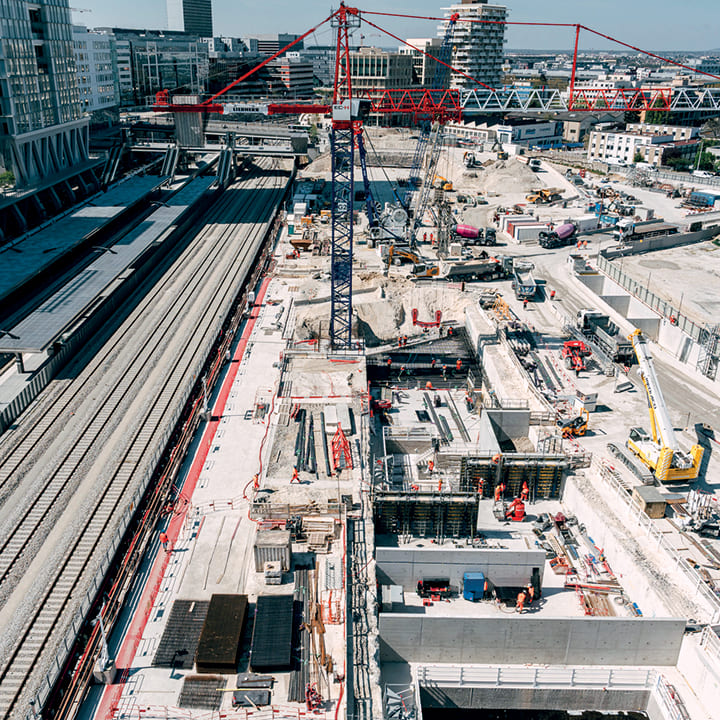
Significant progress is being made on Line 15 West (south section) of the Grand Paris Express, with the launch of the first TBM from the future Nanterre-La-Folie station and headway on the foundations and civil engineering for the stations and ancillary structures.
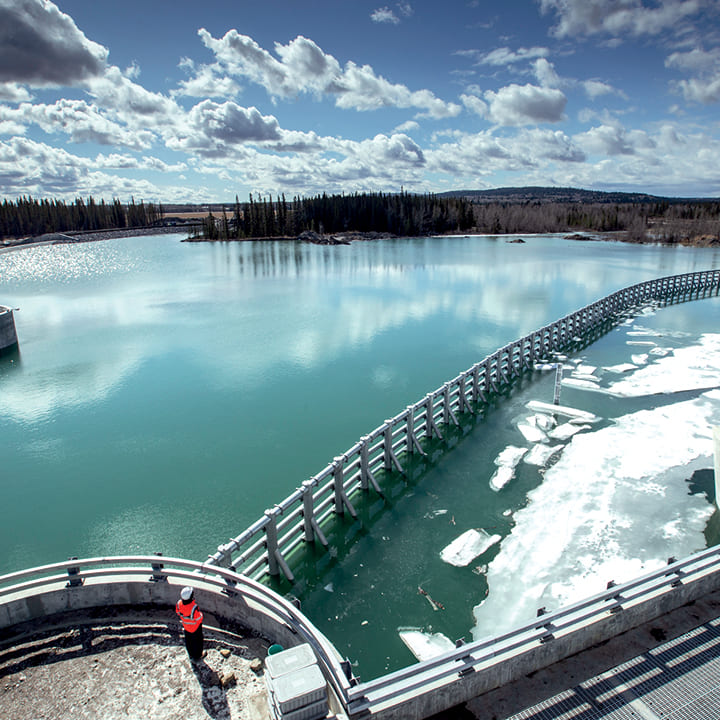
In Canada, the Springbank reservoir project is entering its final phase: it has been designed to protect Calgary from flooding by diverting up to 600 cu. metres of water per second.
For the Major Projects Division, which designs and builds complex civil engineering struc-tures, particularly in the energy, hydraulics, environment, building and mobility sectors, 2025 was a mixed year as a number of project phases came to a close. Orders remain high, repre-senting nearly two years of activity, and prospects for new business are strong, particularly in transport, energy and water treatment. The Division remains committed to carrying out showcase projects, particularly in Europe, Oceania and the Americas. Many of these projects are carried out on a design-build basis and rely heavily on synergies with other VINCI Construction companies.
In 2025, business was brisk in transport infrastruc-ture. The Major Projects Division sets the standard in this area, with a number of significant achievements.
- In France, work continued to move forward on several large projects. Significant progress was made on Line 15 West (south section) of the Grand Paris Express, with the launch of the first tunnel-boring machine (TBM) from the future Nanterre-La-Folie station (in a suburb of Paris), and on the foundations and civil engineering for the stations and ancillary structures. On the Euralpin Lyon–Turin tunnel project, which aims to decarbonise freight transport and improve passenger mobility, TBM Viviana began boring a 9 km section, while the ventilation shafts at Avrieux (south-east France) cleared several deci-sive technical milestones. In particular, work on the project led to the development of an innovative tele-scopic concrete sprayer to apply concrete safely in environments with very low headroom. The sprayer is currently being used by crews at several stations on Line 15 West (south section) of the Grand Paris Express. In Nantes, Major Projects teams are working in synergy with Civil Engineering France on the project to transform the Anne-de-Bretagne bridge.
- In the UK, the High Speed 2 rail project to connect London to northern England continues to move ahead, with all tunnelling work now complete. This ambitious infrastructure asset aims to reduce reliance on cars and domestic flights, thereby contributing to the shift to low-emission mobility.
- The Major Projects Division also achieved substantial progress in Northern Europe. The Fehmarnbelt Fixed Link, between Denmark and Germany, which is set to become the world’s longest immersed tunnel, reached a major milestone when the first 73,500-tonne components were pushed into the lower basin prior to being immersed. By reducing travel time between the Danish and German coasts to 7 minutes by train and 10 minutes by car at the start of the next decade, the tunnel will boost trade in Northern Europe while helping to reduce carbon emissions from transport.
- In Canada, several strategic projects are contributing to the transformation of the country’s infrastructure. In Toronto, the Ontario Line metro project reached a milestone with the completion of excavation at Moss Park station. In Montreal, reno-vation work on one tube of the Louis-Hippolyte La Fontaine tunnel was completed and work on the second tube began.
- In the US, the project to modernise and widen the Hampton Roads Bridge-Tunnel (HRBT) in Virginia reached a decisive stage with the final breakthrough of the second tunnel, a milestone in the largest highway construction project in the state’s history. Several sections also opened to traffic during the year. In Chicago, work began on the Red Line Extension project, which aims to improve access to public transport for disadvantaged communities in the city’s Far South Side.
- In Latin America, the Bogotá–Girardot highway, operated by VINCI Highways, is improving traffic flow towards the south of Colombia, following the addition of a third lane and implementation of innovative environmental solutions. In Chile, Santiago airport, which is managed by VINCI Airports, inaugurated the newly completed facilities from the final phase of its expansion and modernisation project and is now poised to cater to the increase in national and international air traffic.
- In Oceania, following a successful timetable test, the Auckland City Rail Link is on track to open in 2026.