
VINCI Airports works continuously across its entire network to increase the efficiency of its operations and make the travel experience smoother, safer and more enjoyable for passengers. Among the many distinctions earned as a result of this programme, Belgrade airport in Serbia, Porto in Portugal and Guanacaste in Costa Rica were named best airport in their respective categories for quality of service by Airports Council International (ACI). Osaka airport in Japan was rated best airport for on-time departure by Cirium, the leading source of aviation analytics. In the United Kingdom, London Gatwick became the country’s first airport to receive ACI’s Level 1 Accessibility Enhancement Accreditation.
Innovation contributes to the improvement in service quality. At Lyon-Saint Exupéry, for instance, VINCI Airports launched ZenLine, a service that passengers can access from the airport app up to one week in advance, allowing them to reserve a time slot for priority passage without having to wait at security control points.
Environmental strategy
VINCI Airports aims to achieve net zero emissions for its direct scope (Scopes 1 and 2) by 2030 for its airports in the European Union, as well as London Gatwick and Edinburgh, and by 2050 in the rest of the world. As part of this strategic priority, all airports in the network join Airports Council International’s Airport Carbon Accreditation (ACA) programme to guide and provide independent certification of the progress made in reducing their carbon footprint. By the end of 2024, more than 60 of them had obtained ACA accreditation, with four awarded the highest level – Level 5 – which recognises and certifies efforts to achieve and maintain net zero emissions in airports’ direct scope of activity, while also deploying an action plan with their stakeholders. Toulon Hyères, the first airport in France to have obtained this level, was given the ACI Eco-Innovation award for its performance. By the end of 2024, the programmes implemented at each airport had already enabled VINCI Airports to reduce its direct emissions by 53% from their 2018 levels.
These programmes include a set of initiatives focusing primarily on energy efficiency, thermal renovation of buildings, electrification of service vehicles and installation of solar power plants on airport land, for which VINCI Airports draws on the expertise of its specialised subsidiary SunMind (see also page 72). At the end of 2024, the 39 plants in operation across the network’s airports had a total installed capacity of 72.3 MW. As well as directly powering airport infrastructure, these installations feed excess energy into the grid and thereby support the surrounding regions’ energy transition.
At Lyon-Saint Exupéry, for instance, two large solar power plants are currently being built on car park canopies, one for self-consumption (car park P4, 4 hectares), the other on a 5,800 place car park (P5, 14 hectares), which will produce 24 GWh a year, equivalent to the consumption of 9,000 residents in neighbouring municipalities. Meanwhile, in 2024, the airport launched a programme, in partnership with TotalEnergies, to install 800 electric vehicle charge points powered by renewable electricity across all its car parks for the use of passengers, airport staff and local residents.
VINCI Airports’ environmental strategy also aims to reduce its indirect emissions by encouraging partners to decarbonise their own activities, through initiatives such as adjusting airport landing fees based on aircraft emissions, providing sustainable aviation fuels (SAF) available in 2024 at three French airports (Clermont-Ferrand, Toulon Hyères and Saint-Nazaire Montoir) and electrification of ground operations for aircraft. On this point, VINCI Airports, with European Union support, has launched construction of 12 electricity substations on the apron at Nantes Atlantique airport to prevent aircraft from using their auxiliary power units when on the ground.
On a more long-term view, VINCI Airports is collaborating with industrial players in its sector to develop the use of clean hydrogen in aviation. A partnership bringing together Airbus and the London Gatwick, Lyon-Saint Exupéry and Kansai airports was launched in 2024 to create hubs encompassing liquid hydrogen supply chains, storage and aircraft refuelling facilities. VINCI Airports also participates, alongside Airbus, in the European GOLIAT project, to design and produce test infrastructure for liquid hydrogen distribution, which could be trialled at Lyon-Saint Exupéry in 2027.
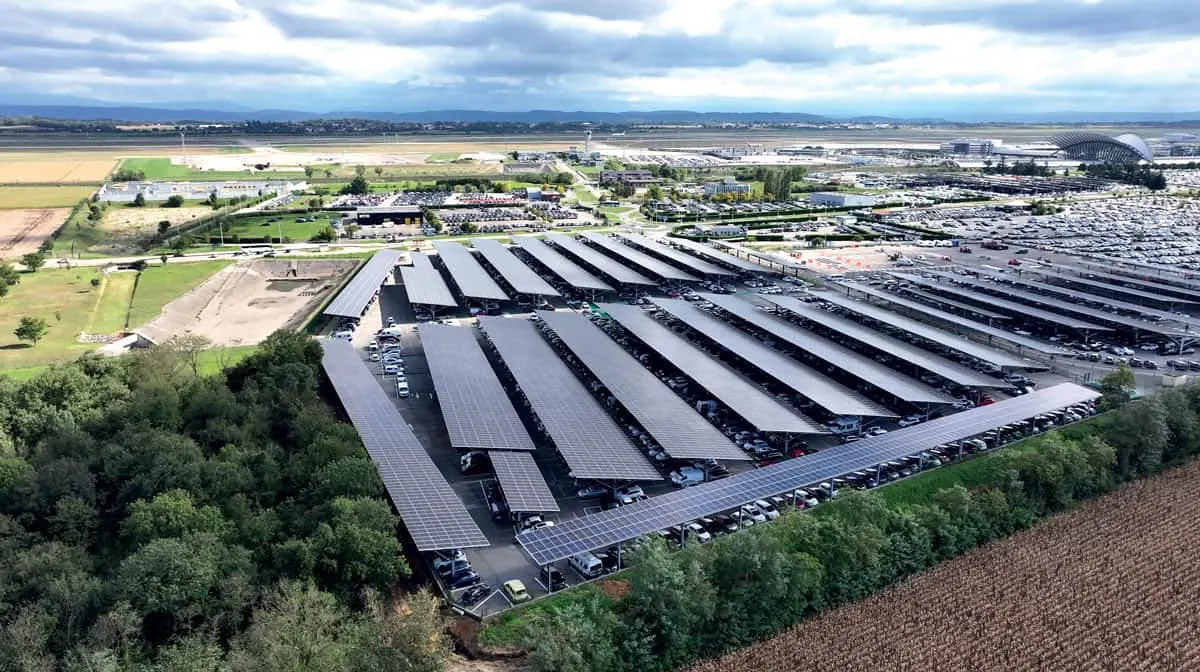
The solar canopies currently being installed on car parks at Lyon-Saint Exupéry airport will power charging stations for electric vehicles, among other uses.