
Progress against the Group’s direct emissions reduction target
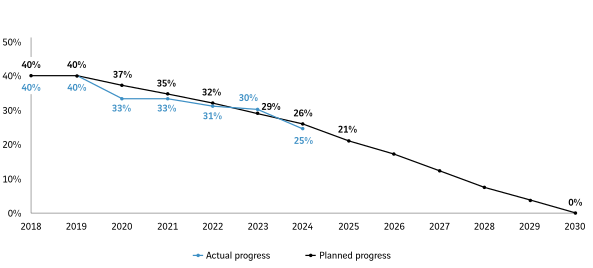
This chart tracks the Group's carbon trajectory.
Actual progress:
- 2018: 40%
- 2019: 40%
- 2020: 33%
- 2021: 33%
- 2022: 31%
- 2023: 30%
- 2024: 25%
Planned progress:
- 2018: 40%
- 2019: 40%
- 2020: 37%
- 2021: 35%
- 2022: 32%
- 2023: 29%
- 2024: 26%
- 2025: 21%
- 2030: 0%
This 40% reduction target between 2018 and 2030 follows on from the previous environmental commitment from the VINCI Manifesto for the period from 2007 to 2018. This commitment resulted in a 25% reduction in the Group’s emissions between 2009 and 2018, which was expressed in terms of intensity relative to revenue. At 31 December 2024, a 25% reduction relative to the level reached in 2024 is needed to meet the 2030 target, which positions the Group slightly ahead (by 1 point) of its planned progress.
2.3 Optimising resources thanks to the circular economy (ESRS E5)
In a context of increasing scarcity of natural resources, some of which are essential to the operation of its businesses, VINCI seeks to limit the footprint of its activities by promoting a circular economy approach. The Group’s approach involves improving design and manufacturing processes to extract less virgin materials, adopting efficient technologies and behaviours, and expanding reuse and recycling to reduce waste. Circular economy initiatives are locally rooted, in accordance with the diversity of the businesses and geographies in which the Group’s companies operate.
2.3.1 Identification of material impacts, risks and opportunities
To identify the main impacts, risks and opportunities (IROs) associated with resources and the circular economy, as part of its double materiality assessment (see section 1, “General information”, page 188), the Group conducted internal analyses and made use of existing research. For example, a 2022 environmental risk map for purchasing in France was used as a starting point for identifying main resource inflows and prioritising the associated risks. The double materiality assessment covered own operations and the entire value chain, including upstream and downstream processes, from the extraction of virgin materials to the end of life of products and waste produced by the Group. The material IROs that were identified and the relevant stakeholders are presented in the table below.
| Material impacts, risks and opportunities | Businesses concerned | Position in the value chain and on the time horizon | Stakeholders concerned |
|---|---|---|---|
| Waste | |||
|
Negative impact: waste generated from the Group’s operations Degradation of natural spaces and habitats and pollution of soil, water and air related to poor management of waste from the Group’s operations (worksites, etc.) |
Negative impact: waste generated from the Group’s operations Degradation of natural spaces and habitats and pollution of soil, water and air related to poor management of waste from the Group’s operations (worksites, etc.) Businesses concerned All |
Negative impact: waste generated from the Group’s operations Degradation of natural spaces and habitats and pollution of soil, water and air related to poor management of waste from the Group’s operations (worksites, etc.) Position in the value chain and on the time horizon
|
Negative impact: waste generated from the Group’s operations Degradation of natural spaces and habitats and pollution of soil, water and air related to poor management of waste from the Group’s operations (worksites, etc.) Stakeholders concerned
|
|
Positive impact: creation of recycling systems and user awareness-building Direct contribution to waste reduction and recycling by developing waste treatment and recycling facilities and by raising the awareness of Group infrastructure users |
Positive impact: creation of recycling systems and user awareness-building Direct contribution to waste reduction and recycling by developing waste treatment and recycling facilities and by raising the awareness of Group infrastructure users Businesses concerned
|
Positive impact: creation of recycling systems and user awareness-building Direct contribution to waste reduction and recycling by developing waste treatment and recycling facilities and by raising the awareness of Group infrastructure users Position in the value chain and on the time horizon
|
Positive impact: creation of recycling systems and user awareness-building Direct contribution to waste reduction and recycling by developing waste treatment and recycling facilities and by raising the awareness of Group infrastructure users Stakeholders concerned
|
| Resource inflows including resources used | |||
|
Negative impact: depletion of resources |
Negative impact: depletion of resources Businesses concerned VINCI Construction |
Negative impact: depletion of resources Position in the value chain and on the time horizon
|
Negative impact: depletion of resources Stakeholders concerned Nature |
|
Opportunity: production of recycled materials Increase in revenue from the production and sale of recycled materials |
Opportunity: production of recycled materials Increase in revenue from the production and sale of recycled materials Businesses concerned VINCI Construction |
Opportunity: production of recycled materials Increase in revenue from the production and sale of recycled materials Position in the value chain and on the time horizon
|
Opportunity: production of recycled materials Increase in revenue from the production and sale of recycled materials Stakeholders concerned
|
2.3.2 Circular economy strategy (policies, objectives and action plans)
VINCI’s circular economy strategy includes three levers to address the material impacts, risks and opportunities identified by the Group:
- promoting the use of construction techniques and materials that economise on natural resources (see paragraph 2.3.2.1, “Promoting the use of construction techniques and materials that economise on natural resources”, page 219) to fight resource depletion;
- improving waste sorting and recovery (see paragraph 2.3.2.2, “Improving waste sorting to implement waste recovery more widely across the Group’s businesses”, page 220) to limit the impacts of waste generation, especially by creating recycling systems and building user awareness;
- increasing the supply of recycled materials and processing facilities (see paragraph 2.3.2.3, “Increasing the supply of recycled materials and processing facilities”, page 222).