
4.1.2.6 Benefits in kind
Executive and non-executive officers have the use of a company car.
4.1.2.7 Overview of the remuneration policy
On the basis of the above structure, this remuneration policy has the following features:
| It is balanced. | It achieves a balance between:
|
|---|---|
| It is capped. | It is capped. It achieves a balance between:
Each of its elements has an upper limit:
|
| It is subject, for the most part, to demanding performance conditions. | It is subject, for the most part, to demanding performance conditions. It achieves a balance between:
Future performance is assessed in relation to past performance. |
| It is in the interests of the Company. | It is in the interests of the Company. It achieves a balance between:
Its amount is moderate, given theVINCI Group’s size and complexity. The performanceconditions selected by the Board encourage Executive Management to consider not only short-term, but also long-term, and evenvery long-term, objectives. |
| It is in keeping with the Company’s business strategy and helps ensure continuity. | It is in keeping with the Company’s business strategy and helps ensure continuity. It achieves a balance between:
The VINCI Group has a business model based on a complementary set of activities conducted over both short and long time frames. These businessescan only prosper over the long term if they are geographically diversified and respect stakeholders and the environment where they are pursued. The remuneration system aptly reflects these imperatives. |
4.1.2.8 Items of remuneration subject to shareholder approval in accordance with Article L.22-10-8 II of the French Commercial Code
At the Shareholders’ General Meeting of 17 April 2025, in accordance with the provisions of Article L.22-10-8 II of the French Commercial Code, shareholders will be asked to vote on the remuneration policies for executive and non-executive officers, as presented above.
4.1.3 Comparative information
4.1.3.1 External benchmarking exercise
Chairman and Chief Executive Officer
At the request of the Remuneration Committee, a benchmarking exercise relating to the components of the Chairman and Chief Executive Officer’s remuneration package was conducted by an independent firm. The aim of such an exercise is to ensure that the remuneration of the Group’s top executive remains coherent and in line with market practice. The most recent update was based on the latest publicly available information relating to the 2023 financial year.
For the purposes of this exercise, the Remuneration Committee selected two representative peer groups, the first comprised of French industrial companies in the CAC 40 (the “French peer group”), and the second comprised of European companies with operations in the construction sector or infrastructure concessions (the “International peer group”).
These two peer groups are as follows:
| French peer group | Air Liquide, Bouygues, Danone, Engie, EssilorLuxottica, Legrand, L’Oréal, Michelin, Pernod Ricard, Renault, Safran, Saint-Gobain, Schneider Electric, Stellantis, TotalEnergies, Veolia |
|---|---|
| International peer group | Aéroports de Paris, Bouygues, Eiffage, Fraport, Hochtief, Strabag, ACS, Ferrovial, Skanska, Mundys (formerly Atlantia), Webuild, Atlas Arteria |
The charts below situate VINCI in relation to the median and the third quartile of each of these peer groups and show that VINCI is positioned above the peer groups in terms of revenue and number of employees. In 2023, VINCI’s market capitalisation was below the third quartile of the French peer group and above the third quartile of the International peer group.
VINCI vs median of peer groups in 2023
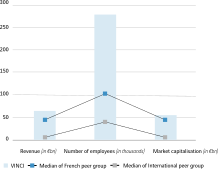
This graph compares VINCI's data with the panel median in three key areas: sales, number of employees and market capitalization.
In 2023, VINCI generated sales of approximately €60bn. The Median of the French peer group had sales of approximately €40bn. The Median of the International peer group generated sales of approximately €10bn.
VINCI had more than 270,000 employees, well above the Median of the French peer group, which had approximately 100,000 employees, and the Median of the International peer group, with approximately 40,000 employees.
In terms of market capitalization, VINCI is worth approximately €45bn. The Median of the French peer group is approximately €40bn, and the Median of the International peer group is approximately €10bn.
VINCI vs third quartile of peer groups in 2023
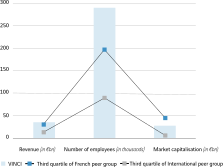
This graph shows VINCI's position in relation to the median and third quartile of each panel, and shows that VINCI is well above these panels in terms of sales, number of employees and market capitalization.
In 2023, VINCI had sales of approximately €40bn, the third quartile of the French peer group is approximately €40bn, and the Third quartile of the International peer group is around €20bn.
In terms of number of employees, VINCI employed 290,000 people in the same year, compared with approximately 200,000 in the third quartile of the French peer group and approximately 90,000 in the Third quartile of the International peer group.
In terms of market capitalization, VINCI was worth around €30bn, compared with approximately €50bn for the third quartile of the French peer group, and around €10bn for the Third quartile of the International peer group.
Source : Mercer.