
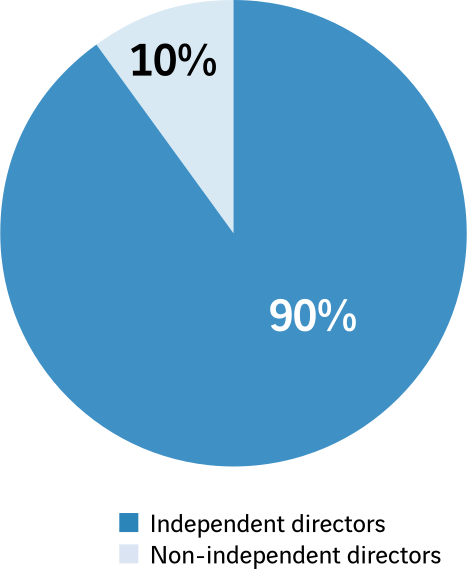
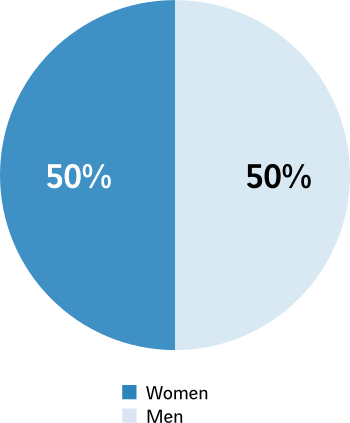
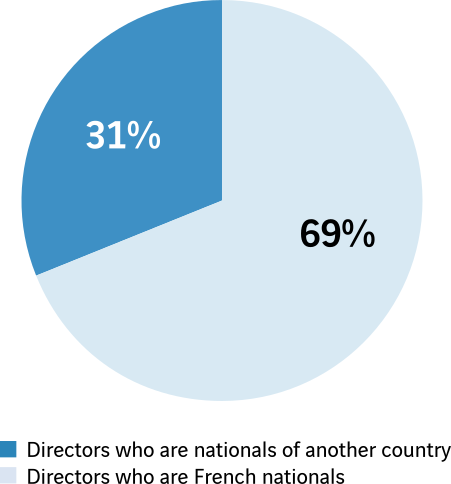
The main characteristics of the Board’s membership at 31 December 2024 are summarised below: (*)
Average age64.4
Average tenure6.7 years
Independence(*) (**)
Gender balance(*) (**)
Internationalisation
The average representations of independent directors and women on the Board and its committees in 2024 are shown in the table below:
| Structure | Average percentage of independent non-executive directors in 2024 | Average ratio of women to men in 2024 |
|---|---|---|
| Board of Directors |
Board of Directors Average percentage of independent non-executivedirectors in 2024 75.9% |
Board of Directors Average ratio of women to men in 2024 0.81 |
| Audit Committee |
Audit Committee Average percentage of independent non-executivedirectors in 2024 100% |
Audit Committee Average ratio of women to men in 2024 1 |
| Strategy and CSR Committee |
Strategy and CSR Committee Average percentage of independent non-executivedirectors in 2024 63.0% |
Strategy and CSR Committee Average ratio of women to men in 2024 0.59 |
| Remuneration Committee |
Remuneration Committee Average percentage of independent non-executivedirectors in 2024 75.0% |
Remuneration Committee Average ratio of women to men in 2024 1 |
| Appointments and Corporate Governance Committee |
Appointments and Corporate Governance Committee Average percentage of independent non-executivedirectors in 2024 80.0% |
Appointments and Corporate Governance Committee Average ratio of women to men in 2024 1.5 |
As recommended by the Afep-Medef code, the Board regularly reviews its composition so as to ensure balance, particularly in terms of diversity (gender representation, age, nationalities, international profiles, expertise). The results of this policy are summarised in the table below:
| Diversity objective | Observations | At 31 December 2024 |
At the close of the Shareholders’ General Meeting of 17 April 2025 (**) |
||
|---|---|---|---|---|---|
| Number of directors | 13 | 15 | |||
| At least 50% of directors deemed independent in accordance with Article 10.3 of the Afep-Medef code | The two Directors representing employees and the Director representing employee shareholders are not taken into account (see paragraph 3.3.2, page 143) | 9/10 (*) | 90 % | 9/12 (*) | 75 % |
| Improved gender balance (number of women on the Board) | The two Directors representing employees and the Director representing employee shareholders are not taken into account | 5/10 (*) | 50 % | 6/12 (*) | 50 % |
| International reach (number of directors who are foreign or dual nationals) | 4/13 (*) | 31 % | 5/15 (*) | 33 % | |
| Directors representing: – employees – employee shareholders |
|
|
|||
The term of office of directors is four years. The Company’s Articles of Association provide that no one may be appointed or reappointed as a director after reaching the age of 75. In addition, no more than one-third of the directors in office at the close of the financial year for which shareholders are asked to approve the financial statements may be over 70.
The average age of directors in office was 64.4 at 31 December 2024, at which time two of them were over 70.
3.1.2 Areas of expertise of Board members
Directors were asked to evaluate themselves individually with respect to their general, business-related or cross-sector skills, the latter involving in particular digital, AI and cybersecurity, the environment, ethics and social issues, based on a scale including several levels of expertise, which was developed by the Company and approved by the Lead Director. Emphasis was placed on the skills identified as essential to effectively fulfil the duties of a VINCI director, given the scope and nature of both the Group’s business activities and its strategy, and taking into consideration the crucial importance of ESG skills among these key areas of expertise. This survey found that a very large majority of Board members consider that they have strong expertise and experience in matters relating to corporate social responsibility, including environmental concerns, ethics and social issues. The Board thus benefits from extensive knowledge and comprehension of all ESG issues involved in its work. The analysis also drew on the answers provided by directors to the questionnaire that was sent to them.