
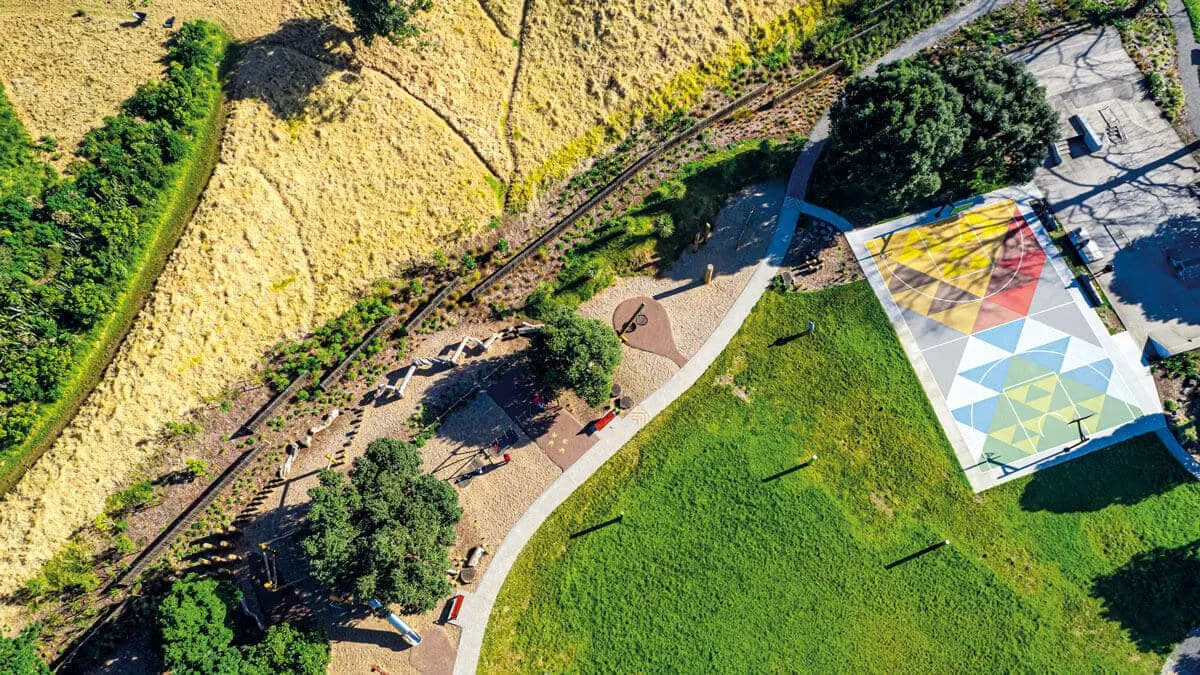
Development of a recreational space (Whānau Ātea) in Auckland, New Zealand.
Oceania
Business volume in this area generated revenue of €1.1 billion (down 9%).
Australia
Seymour Whyte completed the major Sydney Gateway project (a new 5 km motorway section servicing Sydney airport, 19 bridges and 3 km of shared lanes), the Healesville–Koo Wee Rup Road upgrade, the first phase of work on Melbourne airport and the replacement of the Nelligen Bridge in Batemans Marine Park. The subsidiary won new contracts for road infrastructure (widening of a 3.8 km section of Mamre Road in Sydney, extension and renovation of Clyde Road in Melbourne), airport infrastructure (second phase of the Melbourne airport development project, encompassing the forecourt and an elevated road) and hydraulic works including the upgrading and expansion of water treatment facilities in Canberra with VINCI Construction Grands Projets, the modernisation of Cressbrook Dam near Toowoomba, and the engineering, procurement and construction management (EPCM) services contract for hydraulic works with utility Sydney Water.
In the rail sector, one highlight was the acquisition of a 51% stake in specialist company Taylor Rail and the biggest commercial success was the award of a major contract to upgrade a section of the North Coast Line, north of Brisbane, including track duplication and building or renovating several bridges.
New Zealand
HEB Construction continued work on the Ō Mahurangi-Penlink road project north of Auckland (7 km of road and six bridges) and the new Te Ahu a Turanga-Manawatū Tararua Highway (11.5 km) on North Island, and carried out several engineering works including the Te Ara Pekapeka-Peacocke Bridge over the Waikato river (180 metres long, 1.6 km of new road), the Ngapipi pedestrian bridge at Ōrākei in Auckland and the Beaumont Bridge on South Island (192 metres long). In addition, the subsidiary completed the marine works at the new harbour in Ōpōtiki on North Island (construction of two new 450-metre sea walls, the longest in the country, and a 120-metre-wide channel into the Bay of Plenty) and continued work on a new sewage sludge treatment plant in Wellington, which will generate electricity using an innovative thermal hydrolysis process.
Africa
Business shrank by 27% to €0.6 billion as a result of geopolitical instability in certain countries and the completion of several large projects. As a long-standing player in the construction and public works sector in Africa, respected both for the quality of its projects and its social and environmental commitments, Sogea-Satom is a standard-setter in its markets, notably in hydraulic infrastructure and water management. Its expertise is crucial at a time when challenges such as water stress and access to drinking water and sanitation loom large, particularly on the African continent. Numerous projects were won or carried out in this sector, including: in Morocco, the drinking water treatment plant at Beni Mellal at the foot of the Middle Atlas, the seawater desalination plant at Safi on the Atlantic coast and the hydro-agricultural development of the Saïss Plain (13 km of new pipes to irrigate up to 30,000 hectares); in Uganda, the drinking water supply facilities in the Mbarara district, carried out with Major Projects; in Benin, the stormwater drainage project in Cotonou, designed to reduce the risk of flooding and improve rainwater management; in Gabon, development of the Terre Nouvelle watersheds in Libreville; in Côte d’Ivoire, laying of new pipelines from Aghien lagoon to Abidjan, to supply the capital with drinking water.
Sogea-Satom also carried out operations in roadworks (including the Route des Pêches project in Benin and upgrading of urban roads in N’Djamena, Chad), civil engineering (such as the 120-metre-long Tanènè bridge in Guinea and the OCP phosphoric acid plant in Mzinda, Morocco) and construction (including the new Le Carrousel hotel in Rabat and Hampton by Hilton hotel in Ben Guerir, also in Morocco).