
VINCI RAILWAYS
VINCI Railways designs, finances, builds and operates rail and urban transport infrastructure. In France it manages the South Europe Atlantic high-speed line (SEA HSL), the GSM-Rail communications network and a part of the right-of-way public transport system in the French overseas territory of Martinique.
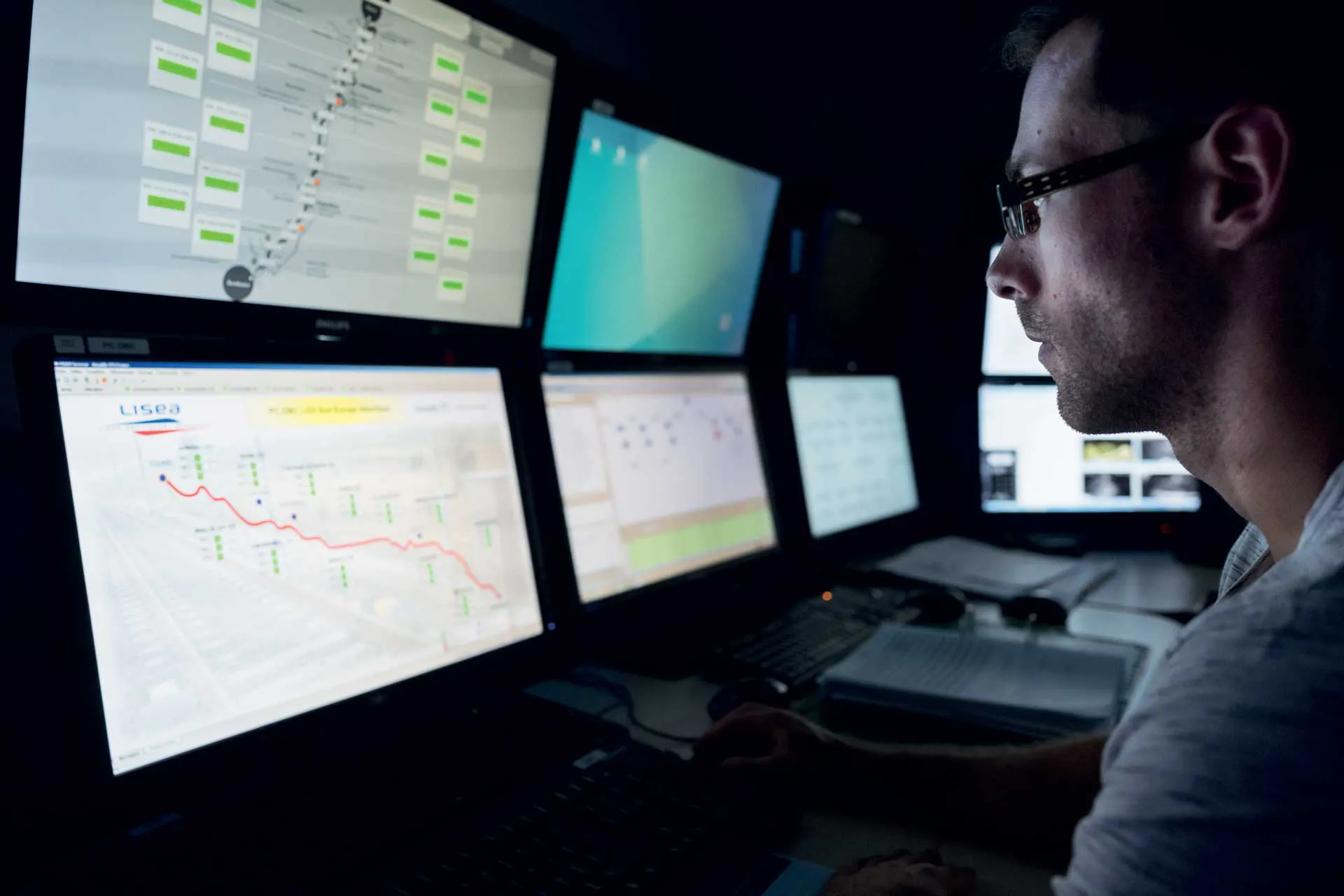
MESEA teams supervise all systems that allow trains to move along the 302 km of the SEA HSL between Tours and Bordeaux.
South Europe Atlantic high-speed line
– Traffic was hit hard by the health crisis in 2020 but picked up in 2021, despite the travel restrictions imposed in France in the spring. Growth as from the summer increased cumulative figures for the full year to 80% of the 2019 level.
– This 302 km South Europe Atlantic high-speed line (SEA HSL) crossing western France between Tours and Bordeaux, designed, financed, built and operated by VINCI Railways and its partners under a concession contract running until 2061, has carried more than 60 million passengers since it was brought into service in July 2017. The socio-economic data collected by the concession company LISEA confirms the rail line’s strong impact on the attractiveness and economic development of the greater Bordeaux area and, more broadly, the south-west region of France.
– To boost this impact, VINCI Railways encourages new rail companies to run services on the line – as part of efforts to open rail passenger transport in France to competition – by guaranteeing high levels of performance. Service regularity (close to 95% since commissioning) and the triple certification for Quality Management (ISO 9001), Environmental Management (ISO 14001) and Occupational Health and Safety Management (ISO 45001) obtained at end-2021 by MESEA – the company responsible for maintenance of the line – reflect this ambition. In addition, MESEA develops innovative methods and tools such as the Broom line inspection vehicle; the TIME (Ticket Incident MEsea) application, which is used to monitor accurate technical data on the line in real time; and, in collaboration with LISEA, the SEACloud platform, which harnesses artificial intelligence to enhance predictive maintenance. LISEA also participates in developing the sector and promoting railway excellence as a member of the organisation Ferrocampus, alongside the Nouvelle-Aquitaine region in south-west France and SNCF.
On the environmental front, implementation is complete of offsetting measures over a total area of 3,800 hectares to limit the line’s impact on the environment and achieve no net loss of biodiversity. LISEA is responsible for monitoring these offsets until the end of the concession contract. As such, it set up the CompenSEA platform, which enables government agencies and environmental organisations to view all environmental data, land cover details and maps in real time for each site. This tool makes it easier to check that the commitments made by the concession company are implemented properly. Moreover, in 2021 LISEA and MESEA created the Fonds SEA pour la Transition des Territoires to drive transition in the region. With a budget of €3 million for the period between 2021 and 2026, the fund will continue to fulfil the commitments made since 2012 to local stakeholders involved in ecological and inclusive transition, by supporting projects that promote professional integration, agro-ecology, reduction of greenhouse gas emissions and biodiversity preservation.
– Furthermore, maintenance and operations teams are gradually switching to electric vehicles and, since its entry into service, have applied the policy to eliminate the use of the herbicide glyphosate in managing plant growth along the line.