
Quality of service is boosted by innovation. After trialling its travel assistant Mona, which uses face recognition to enable service subscribers to pass through control points without any physical contact at Lyon-Saint Exupéry, VINCI Airports debuted the system in Lisbon at the 2021 Web Summit, a major tech industry event. Passengers travelling to the European Union served in testing this seamless new pathway based on biometrics. Lyon-Saint Exupéry airport continued to digitally transform the customer experience with the launch of its Smart Welcome solution. Passengers can now use QR codes positioned in terminals to access a wide range of information and services from their smartphones and opt for physical assistance if they so wish. In Japan, VINCI Airports deploys an autonomous patrolling robot for security operations, while at Kobe airport, travel assistant robots inform and guide travellers within the terminal.
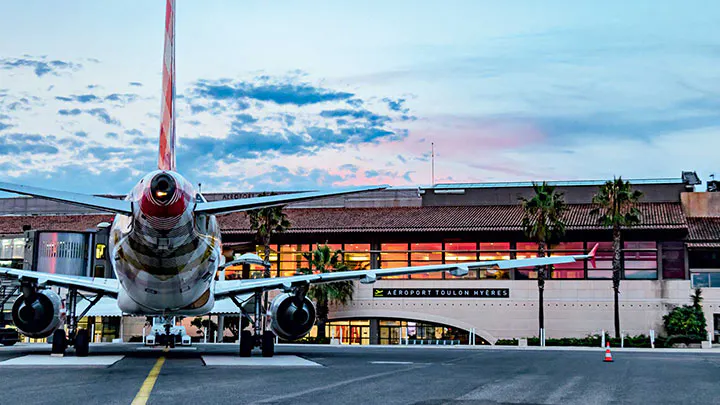
At Toulon Hyères, as at other network airports in France, introduction of a scheme to modulate airport fees to encourage airlines to renew their fleets.
Environmental policy
— In line with the commitments made by the VINCI Group, VINCI Airports has stepped up rollout of its environmental policy, which has made it one of the pioneers in the air transport sector. This ambitious strategy is particularly evident in its large-scale environmental upgrading of new concessions, such as the Salvador Bahia airport in Brazil, which today meets the highest international standards as a result of environmental investments. Its success in this regard is confirmed by awards received from Brazil’s civil aviation authority (Most Sustainable Aerodrome for the second year in a row) and from Airports Council International Latin America & Caribbean (Green Airports Recognition). This strategy can also be seen in the long-term actions implemented to reduce the environmental impact of its activities.
Engaged in the fight against climate change, VINCI Airports – which aims to reach net zero emissions across all its airports by 2050 – is continuing the large-scale rollout of solar farms. In 2021, this programme concerned the Faro (Portugal) and Belgrade (Serbia) airports and will be extended in 2022 to Lyon-Saint Exupéry and Stockholm Skavsta (Sweden). Installed capacity across the network already exceeds 30 MWp. Numerous initiatives such as use of LED light bulbs, re-placing existing heating and air-conditioning units by more energy-efficient systems, and changing to electric service vehicles and runway machinery contribute to reducing the carbon footprint of airport activities.
30 MWp in solar power installed over the VINCI Airports network at end-2021.