
Airport traffic, hit by the health crisis, recovered in the second half of 2021, especially in the European Union and the Americas. While continuing to implement its cost optimisation plan, VINCI Airports expanded in Brazil and France and stepped up deployment of its environmental ambition, with a focus on developing the use of hydrogen in air transport.
Economic data
— As for the global air transport sector, VINCI Airports’ activity was still sharply impacted by the Covid-19 crisis and the resulting travel restrictions in 2021. After a sharp drop in the first half, passenger traffic started to pick up in the summer. This gradual recovery continued until the end of 2021, thanks to better management of the health situation across the world following massive rollout of vaccination campaigns.
— Trends were mixed across geographical regions depending on health restrictions implemented by the different countries. In Europe, VINCI Airports benefited from a strong upswing during the summer season in France, Portugal and Serbia, boosted by introduction of the health pass and the reopening of borders within the European Union. The recovery was even more robust in the Americas, where second-half passenger numbers were close to or even exceeded pre-crisis levels, in particular in the Dominican Republic and Costa Rica, but also in the United States and Brazil. Conversely, passenger traffic remained weak in the United Kingdom and Asia, where very strict rules limited international travel.
— The “traffic mix” of VINCI Airports’ portfolio nonetheless stood to its advantage. Domestic and intracontinental flights, along with VFR (visiting friends and relatives) and tourist travel, which recovered more rapidly, account for a larger share of service than intercontinental and business flights, which are taking longer to return to normal levels. Also of note is that most hubs in the VINCI Airports network continued to record high levels of freight activity, boosted to a great extent by the growth of e-commerce.
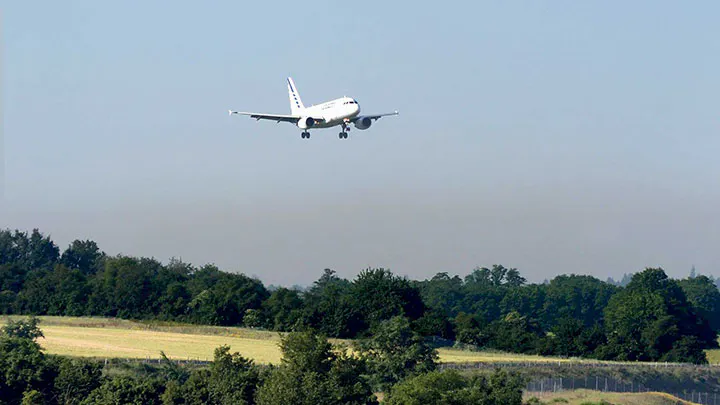
A scheme to modulate airport fees depending on each aircraft’s carbon footprint has been introduced, as here at Lyon-Saint Exupéry.
— Under these circumstances and in compliance with contractual and regulatory obligations, VINCI Airports continued with the cost optimisation plan launched at the start of the health crisis in 2020, taking advantage of its decentralised model to adapt solutions to the local context of each airport. This enabled it to save around €2 billion – compared to pre-pandemic budgets – between March 2020 and December 2021, half from reducing operating expenses and half from postponing investments in areas other than sustainable development.
— At the same time, VINCI Airports took steps to safeguard the financial viability of its assets by renegotiating some contracts and raising additional funds. London Gatwick successfully placed two bond issues to bolster liquidity and obtained the approval of its lenders for temporary relief of its obligation to comply with financial covenants, in view of the exceptionally difficult situation of the air transport sector in the United Kingdom.