
VINCI MANIFESTO AND COMMITMENTS
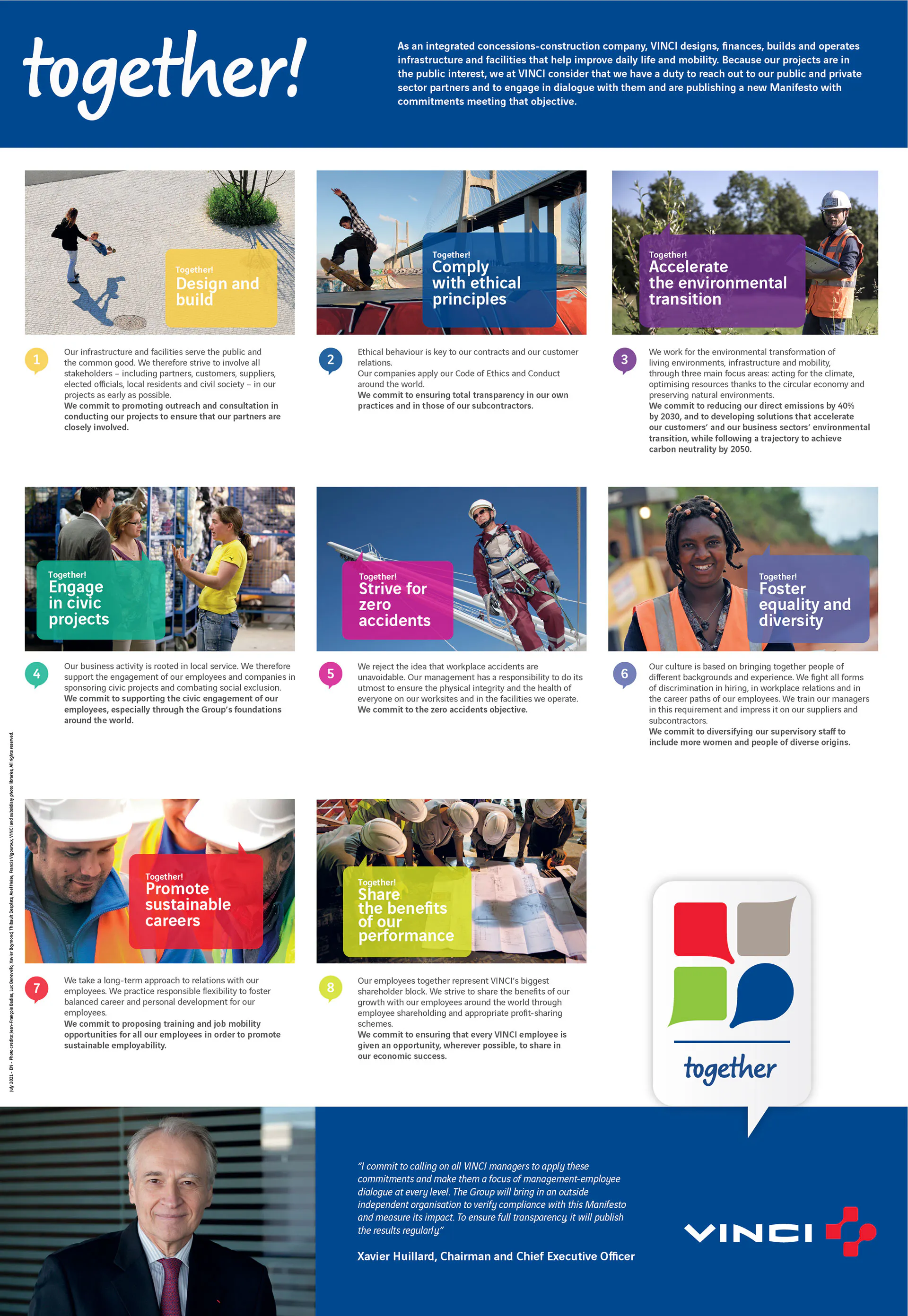
— As a global company and leader in its sector, VINCI must lead by example and work towards the common good. Because its projects serve the public interest, VINCI strongly emphasises listening and dialogue with its stakeholders in all its business lines. In response to the major challenges facing the world today, VINCI aims to be a force for good by actively contributing to the ecological transition, peaceful coexistence and social inclusion in cities and regions. Its humanist corporate culture also impacts the way it looks after its employees.
— This vision is outlined in the VINCI Manifesto, which sets out the values shared by all employees and lays down the Group’s sustainable development commitments to all its stakeholders. Published in some 30 languages, the Manifesto forms a bond between all of VINCI’s businesses and aims to coordinate how its operational entities and their teams act in all countries where it operates.
DECENTRALISED IMPLEMENTATION
— The Group has adopted a decentralised structure based on a network of subsidiaries operating autonomously. This structure requires a high level of accountability from managers and their teams, as they are best placed to identify local issues and problems, as well as the most appropriate solutions. In line with this structure, each entity is responsible – within a common framework set down by the Group – for establishing its own all-round performance targets in light of its businesses and local issues.
SPECIFIC GOVERNANCE
— At the highest level, VINCI’s Board of Directors’ Strategy and CSR Committee is responsible for social, environmental and ethical issues, and for ensuring that these issues are integrated into the Group’s strategy (see page 139).
Trends and issues impacting VINCI’s businesses
| MAIN TRENDS | ANALYSIS AND ISSUES |
|---|---|
| CLIMATE EMERGENCY | CLIMATE EMERGENCY ANALYSIS AND ISSUES According to international benchmark scenarios, climate change risks having a profound effect on today’s lifestyles. There is also growing pressure on natural resources and the environment, at times beyond their capacity to regenerate or adapt. |
| SOCIAL AND WORKFORCE EXPECTATIONS | SOCIAL AND WORKFORCE EXPECTATIONS ANALYSIS AND ISSUES Given social inequality and crises, measures to protect employees, to promote inclusion and integration for all, to improve human rights in value chains and to maintain regional social cohesion have now become crucial. |
| URBANISATION | URBANISATION ANALYSIS AND ISSUES In 2030, 60% of the world’s population will be living in cities, mostly in developing countries. Citizens increasingly want to be involved in development projects. |
| MOBILITY | MOBILITY ANALYSIS AND ISSUES Given today’s rampant urbanisation, demographic and social changes and the climate emergency, sustainable mobility must be created reflecting emerging new needs and a range of uses. |
| DIGITAL TRANSITION | DIGITAL TRANSITION ANALYSIS AND ISSUES Data mining, artificial intelligence and new technologies bring new solutions for the Group’s projects while protecting personal data. |
The Human Resources Department, through its Social Responsibility Department, is in charge of social and workforce-related policy; the Environment Department is responsible for environmental policy, and the Ethics and Vigilance Department for ethics policy under the authority of the Chairman and CEO. The Human Rights, Environment and Ethics and Vigilance committees meet regularly with the representatives of the business lines to identify major issues and implement vigilance practices to prevent human and environmental risks, and to promote the dissemination of measures and best practices.
INTEGRATION OF SUSTAINABLE DEVELOPMENT ISSUES
— VINCI closely tracks and analyses the key trends liable to impact its businesses in the short, medium and long term. The main issues are the environmental emergency, social and workforce expectations, urbanisation, mobility and digital transformation. These shifts may involve risks, but they also provide opportunities. The executive bodies and business lines also ensure they include these issues in the policies they implement.
— The main environmental, social and ethical ambitions are briefly addressed in the following pages. The policies and action plans for each area are detailed in the non-financial performance statement (see pages 172 to 233) and the duty of vigilance plan (see pages 233 to 258).