
The chart below shows that VINCI had 33% remaining on its trajectory at the end of 2021 to reach its 2030 emissions target. Actual progress is 2 percentage points better than the initial baseline thanks to reduction measures taken by Group entities.
VINCI’s emissions reduction trajectory – Progress in 2021
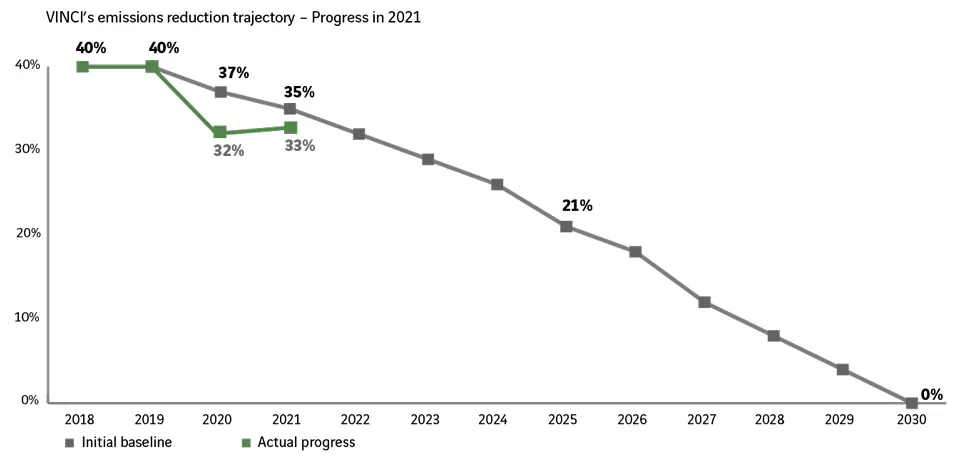
This graph shows that the remaining emissions to be reduced by 2030 are 33%, 2 points ahead of the initial trajectory, following the reduction actions deployed by the Group's entities.
Initial baseline
2020: approximately 37%
2021: approximately 35%
2025: approximately 21%
2030: 0
Actual progress
2018: approximately 40%
2019: approximately 40%
2020: approximately 32%
2021: approximately 33%
This 40% target between 2018 and 2030 follows on from the “Promote green growth together” commitment from the VINCI Manifesto for the period from 2007 to 2018. This commitment resulted in a 25% reduction in the Group’s emissions between 2009 and 2018, which was expressed in terms of intensity relative to revenue.
3.2.1.3 External recognition
VINCI companies have been implementing ambitious policies to combat climate change for many years. Every year, these policies are reviewed by an independent organisation, CDP (formerly the Carbon Disclosure Project). VINCI achieved a score of A in 2021, earning the Group a spot on the CDP “A List”. This achievement reflects the Group’s efforts to provide transparent information about its climate challenges. This project, which is conducted on behalf of 872 investors representing $106 trillion in assets under management, assesses how large companies are responding to climate change.
Additionally, VINCI Airports is involved in the Airport Carbon Accreditation (ACA) programme to reduce greenhouse gas emissions. This programme launched by Airports Council International (ACI) features six levels of accreditation. In 2021, three new airports (Belfast, Santiago and Guanacaste) were certified to Level 2 (Reduction), for a total of 39 airports within the network with ACA certification (see breakdown by level below). All airports in France have signed a commitment agreement with the Union des Aéroports Français (UAF) to reach ACA Level 3 certification in 2022. Lastly, for the first time in Japan, the three airports in the Kansai region reached Level 4 Airport Carbon Accreditation from ACI. These accreditations made VINCI Airports the biggest contributor to the ACA programme again in 2021.
| Level of accreditation | Level 1 (Mapping) | Level 2 (Reduction of Scope 1 and 2 emissions) | Level 3 (Reduction of Scope 3 emissions) | Level 3+ (Carbon neutrality) | Level 4 (Transformation) |
|---|---|---|---|---|---|
| Level of accreditation Number of facilities operated by VINCI Airports |
Level 1 (Mapping) 8 |
Level 2 (Reduction of Scope 1 and 2 emissions) 26 |
Level 3 (Reduction of Scope 3 emissions) 0 |
Level 3+ (Carbon neutrality) 2 |
Level 4 (Transformation) 3 |
In June, for the second year in a row, Salvador Bahia airport received the award for the “Most Sustainable Aerodrome in Brazil” from the country’s civil aviation authority (Anac), and earned the Green Airport Recognition Professional Award at the annual conference of Airport Council International Latin America & Caribbean (ACI-LAC). Aerodom won the same honour.
3.2.2 Reducing the Group’s indirect emissions (Scope 3)
Outside of its direct emissions scope, VINCI is committed, through its environmental ambition, to helping reduce the Group’s indirect emissions by way of actions across its value chain. 2021 was dedicated to consolidating the methodology applied to determine emissions, improving the quality of data for the selected baseline year, and estimating the potential emissions reduction for indirect emissions.
The VINCI Group has pledged to reduce its indirect emissions by 20% by 2030 compared to the 2019 baseline. This commitment has been validated by the Science Based Targets initiative (SBTi) and is based on the emissions categories defined in the Greenhouse Gas Protocol (GHG Protocol). It involves an absolute reduction and covers all emissions categories, upstream and downstream. It also goes beyond mandatory emissions, as defined in the GHG reduction programme, as it covers emissions from motorway traffic. Progress towards achieving this commitment will be monitored at Group level. Over the next few months, VINCI and its entities will define their action plans and will work on developing a reporting system to monitor emissions and their reduction.
Scope 3 target for 2030 20% absolute reduction in indirect emissions from 2019 levels