
3.2.1.1 Actions to reduce direct emissions
| Actions taken | Performance indicators | |
|---|---|---|
| Industrial activities | Industrial activities Actions taken
|
Industrial activities Performance indicators
|
| Vehicles and worksite machines | Vehicles and worksite machines Actions taken
|
|
| Buildings and worksite facilities | Buildings and worksite facilities Actions taken
|
|
| Renewable energy | Renewable energy Actions taken
|
Renewable energy Performance indicators
|
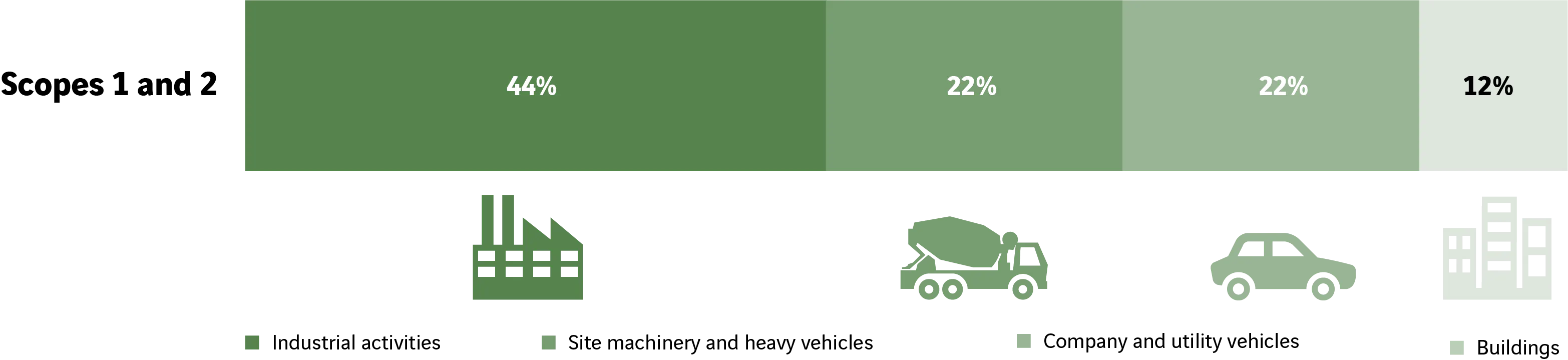
In 2019, in-depth work was carried out on the actions needed to achieve the Group’s Scope 1 and 2 reduction target for its various activities. This approach mobilised all of VINCI’s operational entities and identified the factors for progress and the transformative investments required. Quantitative action plans, including financial aspects, have been adopted for all the business lines. The achievement of the target for a 40% reduction by 2030 requires further technological advances that are under development, which means that there is still some uncertainty as to when they will be completed. In 2021, these action plans, which cover four priority areas for action, were maintained: the energy optimisation of industrial processes and buildings, the environmental performance of site machinery and heavy vehicles, the mobility of VINCI employees, and the decarbonisation of energy used.
- Optimising energy for industrial activities
Due to the industrial nature of its business, Eurovia entities (VINCI Construction) account for a large proportion of the Group’s total energy consumption. Since 2016, Eurovia has developed and implemented its environment strategy, with ambitious energy-efficiency targets for each business segment.
In 2021, industrial facilities continued to reduce their energy consumption, with further investment in switching to electric-powered binder equipment systems at five plants and building materials storage facilities at six plants as well as a new plant offering optimised energy consumption. For example, Eurovia’s asphalt plant in Sainte-Suzanne-et-Chammes in western France has set a standard as a low-carbon plant: material drying stations to reduce energy consumption, more efficient next-generation machines, replacing heavy fuel oil with natural gas as fuel, electric systems for binder storage tanks, increase in the proportion of reclaimed asphalt pavement, thus reducing its CO₂ emissions associated with asphalt production by more than 40%.
The Edrive digital tool was developed and rolled out in 2021 at more than half of Eurovia’s industrial facilities to enable sites to monitor reductions in energy consumption and CO₂ emissions in real time.
- Environmental performance of site machinery and heavy vehicles
The consumption of energy relating to the use of site machinery and heavy vehicles represents 22% of total emissions. To reduce the corresponding emissions, VINCI entities are working with their suppliers to take action in three key areas: monitoring consumption in real time, providing training for operators and modernising their fleets.
To monitor consumption, VINCI Construction has set up the tools Linaster and e-Track, capturing data for machines, trucks and utility vehicles fitted with telematics systems, with a view to optimising their use and therefore their energy consumption. At the end of 2021, several thousand machines and vehicles were connected to e-Track and Linaster. Many entities have also introduced eco-driving training for their operators.
VINCI is investing in modernising its fleet of vehicles and trucks:
- – VINCI Energies is standardising the use of biofuels for its vehicle fleet, based on local availability and guidance from external consultants to assess the indirect effects of biofuels, such as changes in land use. VINCI Energies France has signed a partnership with the biofuel producer Oleo 100 to power some of its heavy vehicles. This can reduce emissions by up to 60% compared to regular diesel;
- – Eurovia bought more hybrid and electric vehicles and machines in 2021 than it had forecast in 2019 as part of the 2030 trajectory.